193 posters, 19 videos, 10 audios, 3 topics, 28 sessions, 709 authors, 279 institutions
ePostersLive by SciGen Technologies S.A. All rights reserved.
9th World Congress on Vascular Access 2026
15 - 17 April, 2026 | Valencia, Spain

228
<p>Hemostatic discs exhibit broad-spectrum antimicrobial activity against pathogens linked to vascular access device infections</p>
Poster Presenter
Part of Topic
“Hemostatic discs exhibit broad-spectrum antimicrobial activity against pathogens linked to vascular access device infections”
Introduction/Background
Vascular access devices play a crucial role in modern healthcare, especially in managing acute and chronic conditions. However, these devices are not without risks. The use of vascular access devices often leads to complications, including post-insertion bleeding and infections. This study aimed to explore these challenges and how recent innovations, such as haemostatic discs, can help mitigate these risks.
Vascular access devices are associated with various healthcare-related harms. For example, compromised haemostatic function can lead to hemoserrous fluid loss at the access site. This not only affects the integrity of the skin and dressings but also opens new portals of entry for infections, potentially leading to severe complications such as central line-associated bloodstream infections.
The infections associated with vascular access devices often stem from endogenous sources. Patient commensal skin flora can migrate along the access device, or opportunistic pathogens from the patient’s microbiota or the healthcare environment can take advantage of the new entry points (Figure 1). This makes continuous assessment and management of bleeding and infection risks crucial during vascular access device placement, removal, and throughout the time the device remains in situ.
Bleeding risks during vascular access device insertion are typically managed through haemostatic bundles. These include careful device and site selection, using ultrasound guidance, manual compression, and site sealing. Achieving haemostasis at the access site is critical, leading to a reduction in the need for frequent dressing changes, minimisation of site breakdown, and lowered infection risks. However, frequent application and removal of adhesive dressings can lead to skin injury, further increasing the risk of infection.
The endogenous microbiota of the skin plays a significant role in vascular access device infections. Even after topical antisepsis, the skin's endogenous microbiota rapidly repopulates, which can lead to infections within seven to ten days of device placement. Most commonly, these infections are caused by Gram-positive bacteria including Staphylococcus aureus and coagulase-negative staphylococci, followed by Gram-negative bacteria and yeast including Candida species.
Infection prevention strategies rely on both physical and chemical methods. In the era of antimicrobial resistance, physical methods have become increasingly important as they reduce microbial load without contributing to selective pressures that promote resistant strains. Our study focused on evaluating the physical efficacy of haemostatic discs, specifically those using a hydrophilic polymer and potassium ferrate, against established vascular access pathogens.
The haemostatic disc we studied showed promising results. Unlike pure chemical controls, these discs do not rely on diffusion of antimicrobial agents into surrounding areas. Instead, they work by creating a physical barrier directly at the access site through the formation of an occlusive seal which absorbs exudate and reduces bleeding risks. Additionally, these haemostatic discs create a low pH environment which inhibits microbial growth.
Methods/Results
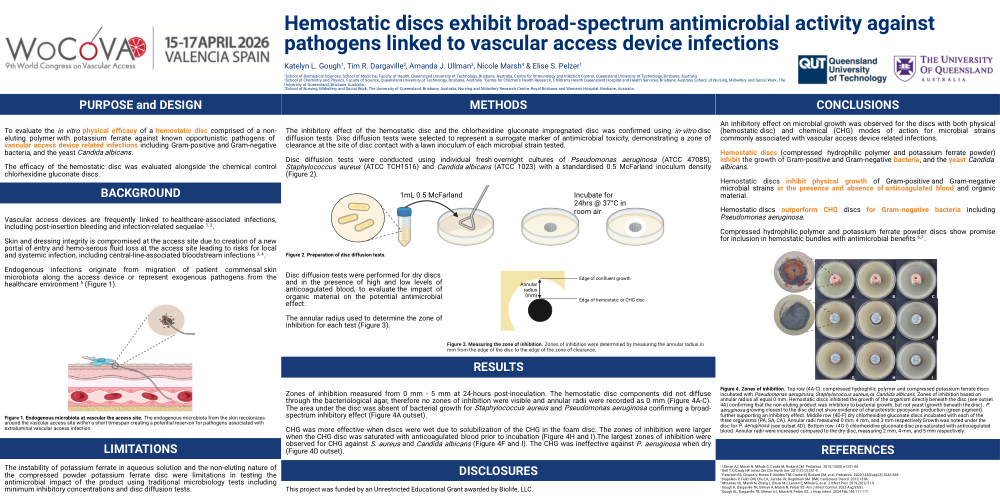
Disc diffusion assays represent a commonly employed method for evaluating antimicrobial susceptibility in vitro. This method is based on diffusion of a chemical antimicrobial agent through semisolid microbiological agar inoculated with a known concentration of fresh overnight, pure culture of the microbial strain of interest as seen in Figure 2. Toxicity associated with an antimicrobial agent results in inhibition of microbial growth in close proximity to an antimicrobial impregnated disc positioned on the surface of the agar plate as 18-24 hours post-inoculation. Microbial strains that display susceptibility to the antimicrobial agents are identifiable by zones of clearing around the edge of the disc in the otherwise confluent lawn of microbial growth covering the surface of the agar plate (Figure 3).
To mimic the in vivo environment, in this study haemostatic and chlorhexidine gluconate impregnated discs were exposed to low and high blood volumes, prior to placement on the surface of the agar. For the haemostatic discs, we observed complete clearance of test strains of bacteria: Pseudomonas aeruginosa and Staphylococcus aureus, at the site of disc placement, indicating strong physical activity against these pathogens in the presence and absence of anticoagulated blood (Figure 4A outset). However, the disc showed limited inhibition against the yeast Candida albicans.
Interestingly, the chlorhexidine gluconate (CHG) disc showed zones of inhibition that increased with exposure to higher volumes of anticoagulated blood (Figure 4F and 4I). However, the efficacy of the CHG disc was reduced against Gram-negative strains compared to Gram-positive strains, with evidence of growth beneath the disc at the site of placement. In contrast, the haemostatic disc performed consistently well against both types of bacteria and was more effective against Gram-negative microbial strains when compared to the CHG disc.
Limitations
The non-eluting nature and chemical properties of the haemostatic disc, including instability in aqueous solution, present limitations to traditional microbiological testing. In this study, we employed disc diffusion experiments to inform future studies.
Conclusion
In conclusion, the hydrophilic polymer and potassium ferrate haemostatic disc shows significant potential as a dual-function device: achieving rapid haemostasis while also reducing microbial growth. Unlike CHG, which has been associated with adverse reactions in some individuals and growing microbial resistance, the haemostatic disc offers a promising physical alternative for infection control at vascular access sites. The haemostatic discs inhibited the growth of key Gram -positive and Gram-negative bacteria in the presence and absence of anticoagulated blood. Outperforming CHG discs for Gram-negative bacteria including Pseudomonas aeruginosa. CHG discs appeared to be more effective when saturated, compared to dry.
Future studies should continue to explore the use of potassium ferrate combined with a hydrophilic polymer in haemostatic discs, particularly in the context of reducing microbial load without contributing to antimicrobial resistance. As we continue to face challenges with resistant pathogens, alternatives like these will become increasingly important in healthcare.