193 posters, 19 videos, 10 audios, 3 topics, 28 sessions, 709 authors, 279 institutions
ePostersLive by SciGen Technologies S.A. All rights reserved.
9th World Congress on Vascular Access 2026
15 - 17 April, 2026 | Valencia, Spain

220
<p>Clinical Characteristics and Complications of Long-Term Central Venous Catheters in Pulmonary Hypertension: A 10-Year Case Series (2016–2025)</p>
Part of Topic
Outcomes of Long-Term Central Venous Access Devices in Pulmonary Arterial Hypertension: A 10-Year Case Series
Carlos F Román-Ortega , Juan Gómez-Sandoval, Valeria Correa-Martinez, Javier Amaya-Nieto, Rafael Conde-Camacho
Background:
Pulmonary arterial hypertension (PAH) affects ~192,000 people globally, with high mortality [1]. Continuous intravenous epoprostenol via central venous access devices (CVADs) is the most effective strategy for pulmonary pressure reduction [2], but CVADs carry a ~30% complication rate including infection, thrombosis, and occlusion [4]. Approximately 80% of these patients live in low- and middle-income countries where evidence is scarce [3].
Methodology:
Retrospective case series (2016–2025) of 18 adult PAH patients requiring CVADs for continuous epoprostenol infusion, managed by a multidisciplinary team.
Results:
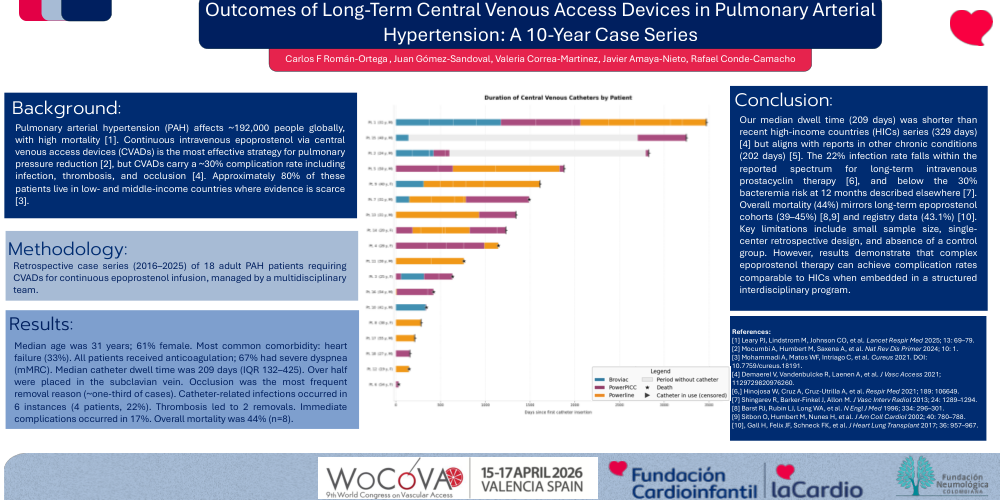
Median age was 31 years; 61% female. Most common comorbidity: heart failure (33%). All patients received anticoagulation; 67% had severe dyspnea (mMRC). Median catheter dwell time was 209 days (IQR 132–425). Over half were placed in the subclavian vein. Occlusion was the most frequent removal reason (~one-third of cases). Catheter-related infections occurred in 6 instances (4 patients, 22%). Thrombosis led to 2 removals. Immediate complications occurred in 17%. Overall mortality was 44% (n=8).
Conclusion:
Our median dwell time (209 days) was shorter than recent high-income countries (HICs) series (329 days) [4] but aligns with reports in other chronic conditions (202 days) [5]. The 22% infection rate falls within the reported spectrum for long-term intravenous prostacyclin therapy [6], and below the 30% bacteremia risk at 12 months described elsewhere [7]. Overall mortality (44%) mirrors long-term epoprostenol cohorts (39–45%) [8,9] and registry data (43.1%) [10]. Key limitations include small sample size, single-center retrospective design, and absence of a control group. However, results demonstrate that complex epoprostenol therapy can achieve complication rates comparable to HICs when embedded in a structured interdisciplinary program.
References:
[1] Leary PJ, Lindstrom M, Johnson CO, et al. Lancet Respir Med 2025; 13: 69–79.
[2] Mocumbi A, Humbert M, Saxena A, et al. Nat Rev Dis Primer 2024; 10: 1.
[3] Mohammadi A, Matos WF, Intriago C, et al. Cureus 2021. DOI: 10.7759/cureus.18191.
[4] Demaerel V, Vandenbulcke R, Laenen A, et al. J Vasc Access 2021; 1129729820976260.
[6,] Hinojosa W, Cruz A, Cruz-Utrilla A, et al. Respir Med 2021; 189: 106649.
[7] Shingarev R, Barker-Finkel J, Allon M. J Vasc Interv Radiol 2013; 24: 1289–1294.
[8] Barst RJ, Rubin LJ, Long WA, et al. N Engl J Med 1996; 334: 296–301.
[9] Sitbon O, Humbert M, Nunes H, et al. J Am Coll Cardiol 2002; 40: 780–788.
[10], Gall H, Felix JF, Schneck FK, et al. J Heart Lung Transplant 2017; 36: 957–967.