193 posters, 19 videos, 10 audios, 3 topics, 28 sessions, 709 authors, 279 institutions
ePostersLive by SciGen Technologies S.A. All rights reserved.
9th World Congress on Vascular Access 2026
15 - 17 April, 2026 | Valencia, Spain

213
<p>Analysis of peripherally inserted central catheters in the Spanish critical care units: Results From PICC-ICU Survey</p>
Poster Presenter
Part of Topic
Analysis of peripherally inserted central catheters in the Spanish critical care units: Results From PICC-ICU Survey
Juan Manuel López-Reina Roldán1; MC. Martín Delgado2 E. Bernal Pérez3; P. Gasco Gasco4; A. Hernández Madrid1,3
1 Universidad de Alcalá. 2 Hospital Universitario 12 de Octubre. 3 Hospital Universitario Ramón y Cajal. 4 Hospital Universitario Príncipe de Asturias.
ABSTRACT
Introduction and objectives: The safer use of central venous catheters are a cornerstone in critical patient. The advantages offered by peripherally inserted central catheters (PICC) make their use growing rapidly in intensive care units (ICU). However, less is known about the number of PICC placement, who and how are inserted. To know about the situation of PICC placement in Spanish ICU is essential for patient safety.
Method: Descriptive, observational and cross-sectional study. Population: ICU nurses that filled out the survey about PICC insertion procedure.
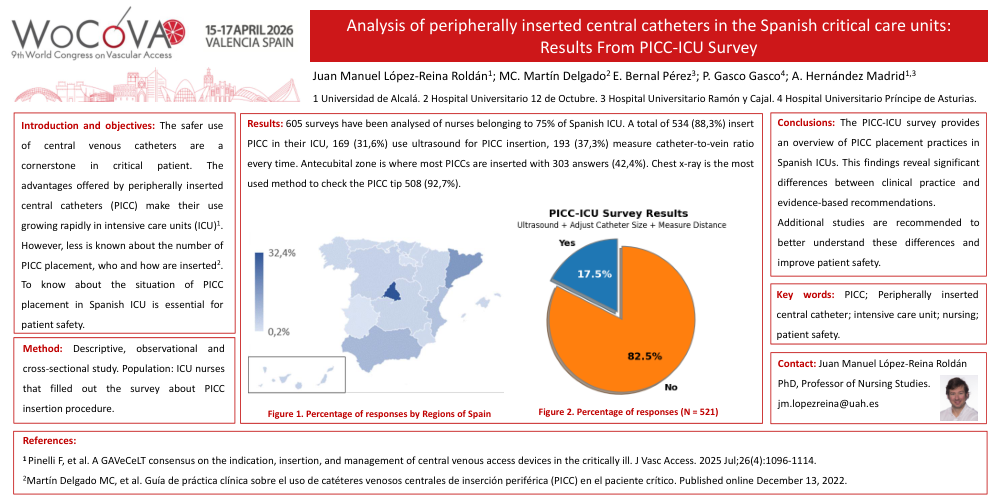
Results: 605 surveys have been analysed of nurses belonging to 75% of Spanish ICU. A total of 534 (88,3%) insert PICC in their ICU, 169 (31,6%) use ultrasound for PICC insertion, 193 (37,3%) measure catheter-to-vein ratio every time. Antecubital zone is where most PICCs are inserted with 303 answers (42,4%). Chest x-ray is the most used method to check the PICC tip 508 (92,7%).
Conclusions: PICC-ICU survey shows the situation in Spanish ICU PICC placements. This research shows important differences between how procedural is achieved and evidence-based recommendations.