193 posters, 19 videos, 10 audios, 3 topics, 28 sessions, 709 authors, 279 institutions
ePostersLive by SciGen Technologies S.A. All rights reserved.
9th World Congress on Vascular Access 2026
15 - 17 April, 2026 | Valencia, Spain

206
<p>Femoral PICC Insertion for Germ Cell Tumour Patients with Mediastinal Mass and SVC Compression: A Safe and Effective Alternative for ambulatory patients receiving chemotherapy.</p>
Poster Presenter
Authors
Affiliations
Part of Topic
Femoral PICC Insertion for Germ Cell Tumour Patients with Mediastinal Mass and SVC Compression: A Safe and Effective Alternative for ambulatory patients receiving chemotherapy
Mediastinal germ cell tumours often present with rapidly progressive mass effect causing superior vena cava (SVC) compression, limiting or contraindicating upper-limb vascular access. Immediate chemotherapy is critical to prevent cardiopulmonary compromise, yet central access options are restricted. Traditional femoral CVCs carry concerns about infection and thrombosis. However, contemporary registry evidence — including RaFeVA and RAVESTO protocols — demonstrates that when femoral access is performed with ultrasound guidance, tunnelling, fluoroscopy, and strict aseptic technique, complication rates are significantly reduced and comparable to upper-limb approaches.
This case series evaluates the feasibility of femoral PICCs for urgent chemotherapy in germ cell tumour patients with severe SVC obstruction.
Three patients (ages 19–34) with large anterior mediastinal germ cell tumours and radiologically confirmed high-grade SVC obstruction underwent femoral PICC insertion. Cases were reviewed through a multidisciplinary approach (oncology, vascular access, anaesthetics, IR).
Procedural techniques:
Ultrasound-guided femoral access, supported by RaFeVA and SIP2 protocols to minimise insertion related, delayed, or late complications.
Subcutaneous tunnelling, consistent with RAVESTO findings demonstrating improved stability and decreased infection risk in non-upper-limb routes.
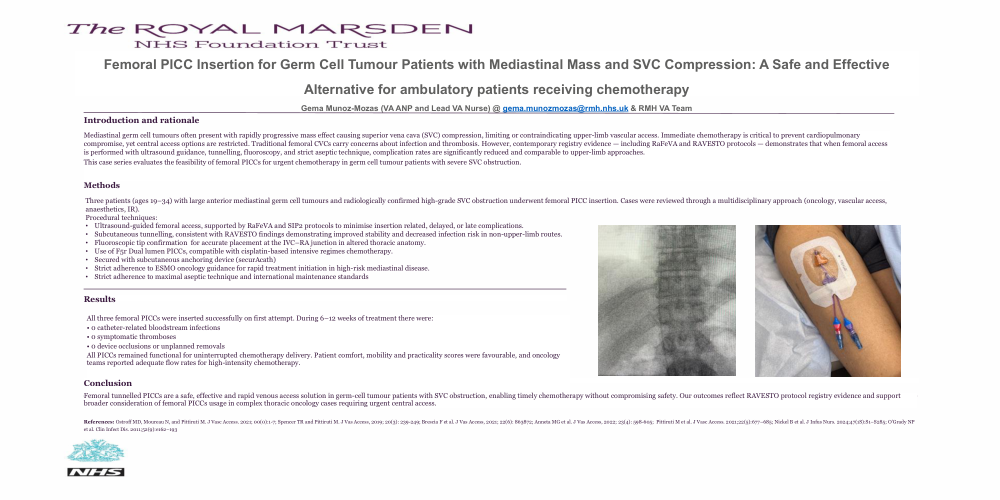
Fluoroscopic tip confirmation for accurate placement at the IVC–RA junction in altered thoracic anatomy.
Use of F5r Dual lumen PICCs, compatible with cisplatin-based intensive regimes chemotherapy.
Secured with subcutaneous anchoring device (securAcath)
Strict adherence to ESMO oncology guidance for rapid treatment initiation in high-risk mediastinal disease.
Strict adherence to maximal aseptic technique and international maintenance standards
All three femoral PICCs were inserted successfully on first attempt. During 6–12 weeks of treatment there were:
• 0 catheter-related bloodstream infections
• 0 symptomatic thromboses
• 0 device occlusions or unplanned removals
All PICCs remained functional for uninterrupted chemotherapy delivery. Patient comfort, mobility and practicality scores were favourable, and oncology teams reported adequate flow rates for high-intensity chemotherapy.
Femoral tunnelled PICCs are a safe, effective and rapid venous access solution in germ-cell tumour patients with SVC obstruction, enabling timely chemotherapy without compromising safety. Our outcomes reflect RAVESTO protocol registry evidence and support broader consideration of femoral PICCs usage in complex thoracic oncology cases requiring urgent central access.