193 posters, 19 videos, 10 audios, 3 topics, 28 sessions, 709 authors, 279 institutions
ePostersLive by SciGen Technologies S.A. All rights reserved.
9th World Congress on Vascular Access 2026
15 - 17 April, 2026 | Valencia, Spain

194
<p><em>Moving the needle: A 3-year quality improvement project in expanding confidence in ultrasound-guided peripheral intravenous cannulation amongst PGY-1 Doctors in a rural Irish hospital</em></p>
Poster Presenter
Part of Topic
Moving The Needle: A 3-year Quality Improvement Project in expanding confidence in Ultrasound-Guided Intravenous Cannulation amongst PGY-1 Doctors in a rural Irish Hospital.
G.Gallagher1, J.Hlasny2
1Anaesthesiology Trainee 2Consultant Anaesthesiologist
1,2Department of Anaesthesiology and Intensive Care, Letterkenny University Hospital, Donegal, Ireland.
Introduction:
Peripheral Intravenous Catheter (PIVC) insertion is the most common invasive procedure in secondary care1. Despite this, PIVC insertion is challenging in multiple cohorts of patients, leading to repeated attempts and subsequent increased anxiety, pain and reduced satisfaction amongst patients2. In Ireland, the responsibility of ensuring IV access in admitted patients frequently falls to PGY-1 Doctors with no formal training in the use of Ultrasound for PIVC insertion. We conducted standardised training sessions with each group of rotating PGY-1 doctors in our hospital over a 3 year period with an aim to instil confidence and proficiency in performing this important procedure.
Methods:
From September 2023-2025 inclusive, we conducted ten formal, small group (<10 attendees) training sessions with PGY-1 doctors who rotate on a bi-annual basis in our institution. These sessions were two hours long, beginning with a 15-minute didactic lecture followed by continuous supervised Ultrasound scanning and needling on high fidelity phantoms until attendees were content they reached proficiency. We prospectively gathered anonymised data in both pre and post-session surveys relating to attendees’ experience, confidence with ultrasound guided PIVC insertion. We also gathered data on number of PIVCs inserted per shift and on whether attendees’ teams had previously contacted our Institution’s Department of Anaesthesiology for help in PIVC insertion.
Results:
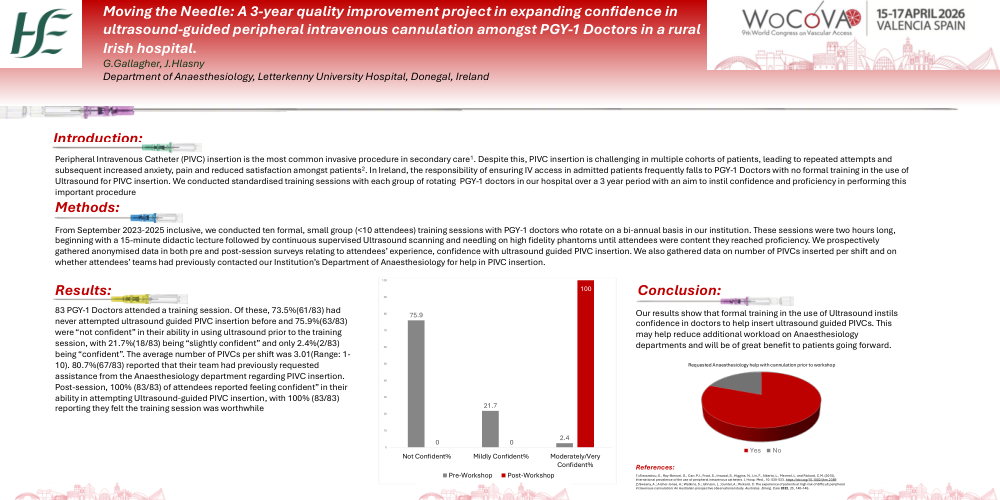
83 PGY-1 Doctors attended a training session. Of these, 73.5%(61/83) had never attempted ultrasound guided PIVC insertion before and 75.9%(63/83) were “not confident” in their ability in using ultrasound prior to the training session, with 21.7%(18/83) being “slightly confident” and only 2.4%(2/83) being “confident”. The average number of PIVCs per shift was 3.01(Range: 1-10). 80.7%(67/83) reported that their team had previously requested assistance from the Anaesthesiology department regarding PIVC insertion. Post-session, 100% (83/83) of attendees reported feeling confident” in their ability in attempting Ultrasound-guided PIVC insertion, with 100% (83/83) reporting they felt the training session was worthwhile.
Conclusion:
Our results show that formal training in the use of Ultrasound instils confidence in doctors to help insert ultrasound guided PIVCs. This may help reduce additional workload on Anaesthesiology departments and will be of great benefit to patients going forward.
References:
1) Alexandrou, E., Ray-Barruel, G., Carr, P.J., Frost, S., Inwood, S., Higgins, N., Lin, F., Alberto, L., Mermel, L. and Rickard, C.M. (2015), International prevalence of the use of peripheral intravenous catheters. J. Hosp. Med., 10: 530-533. https://doi.org/10.1002/jhm.2389
2) Sweeny, A.; Archer-Jones, A.; Watkins, S.; Johnson, L.; Gunter, A.; Rickard, C. The experience of patients at high risk of difficult peripheral intravenous cannulation: An Australian prospective observational study. Australas. Emerg. Care 2022, 25, 140–146.