193 posters, 19 videos, 10 audios, 3 topics, 28 sessions, 709 authors, 279 institutions
ePostersLive by SciGen Technologies S.A. All rights reserved.
9th World Congress on Vascular Access 2026
15 - 17 April, 2026 | Valencia, Spain

192
<p>From repeated access to vascular exhaustion: The impact of multiple punctures in pediatrics</p>
Poster Presenter
Part of Topic
INTRODUCTION:
Vascular access canulation is one of the most traumatic events for hospitalized children. In pediatrics, venous cannulation is often more complex due to risk factors present in up to 25% of patients. Lines placed under stress have shorter dwell times due to complications, contributing to vascular exhaustion.
AIM:
Perform a retrospective obertvational analysis of vascular access cannulations in pediatric patients from December 2021 to December 2024, to identify the most frequent complications and evaluate discrepancies between the latest vascular access algorithms and clinical pactice.
METHODOLOGY:
A retrospective analysis was conducted on 2308 medical records of pediatric patients requiring at least one vascular catheter.
- Inclusion criteria: Patients aged 28 days to 14 years hospitalized during the study period and having a peripheral vascular access, midline catheter, or peripherally inserted central catheter (PICC).
- Exclusion criteria: Cannulations performed outside the pediatric department were excluded.
Stadistical analysis was performed using the IBM SPSS v29 stadistical package.
RESULTS:
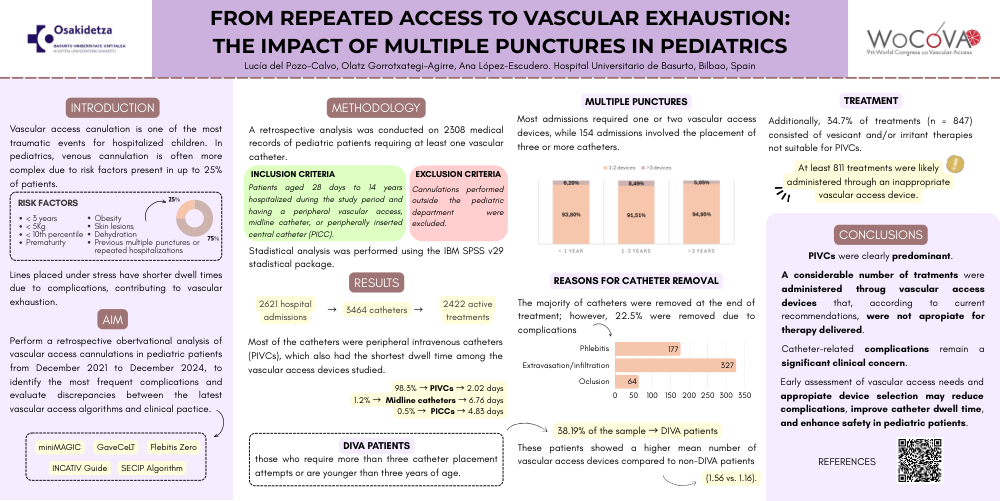
Most of the catheters were peripheral intravenous catheters (PIVCs), which also had the shortest dwell time among the vascular access devices studied.
DIVA patients (38.19% of the sample): those who require more than three catheter placement attempts or are younger than three years of age. These patients showed a higher mean number of vascular access devices compared to non-DIVA patients (1.56 vs 1.16).
Multiple punctures: Most admissions required one or two vascular access devices, while 154 admissions involved the placement of three or more catheters.
Reasons for catheter removal: The majority of catheters were removed at the end of treatment; however, 22.5% were removed due to complications.
Treatment: Additionally, 34.7% of treatments (n = 847) consisted of vesicant and/or irritant therapies not suitable for PIVCs. At least 811 treatments were likely administered through an inappropriate vascular access device.
CONCLUSIONS:
- PIVCs were clearly predominant.
- A considerable number of tratments were administered throug vascular access devices that, according to current recommendations, were not apropiate for therapy delivered.
- Catheter-related complications remain a significant clinical concern.
- Early assessment of vascular access needs and appropiate device selection may reduce complications, improve catheter dwell time, and enhance safety in pediatric patients.