193 posters, 19 videos, 10 audios, 3 topics, 28 sessions, 709 authors, 279 institutions
ePostersLive by SciGen Technologies S.A. All rights reserved.
9th World Congress on Vascular Access 2026
15 - 17 April, 2026 | Valencia, Spain
181
<p>Do we always choose the best CVAD? An evaluation of satisfaction with central venous access device placement in paediatric onco-haematology patients.<em></em></p>
Poster Presenter
Part of Topic
Introduction :
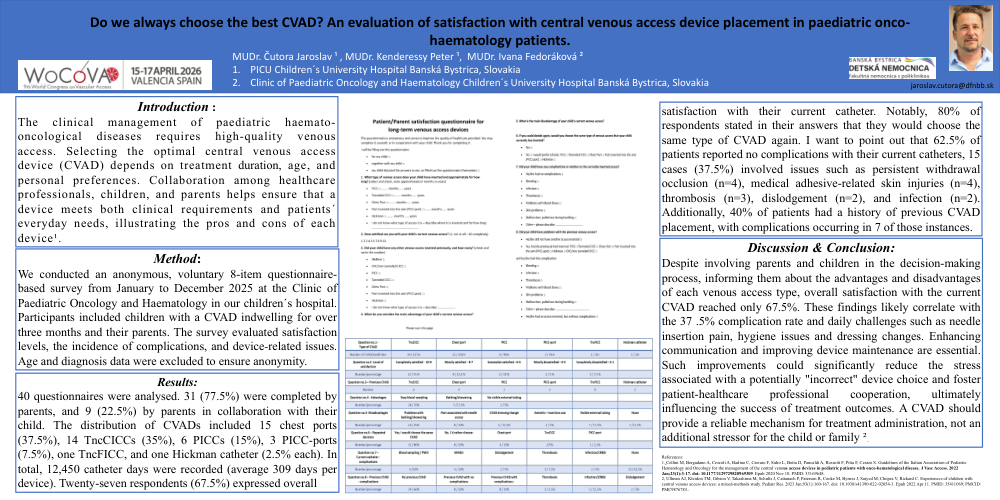
The clinical management of paediatric haemato-oncological diseases requires high-quality venous access. Selecting the optimal central venous access device (CVAD) depends on treatment duration, age, and personal preferences. Collaboration among healthcare professionals, children, and parents helps ensure that a device meets both clinical requirements and patients´ everyday needs, illustrating the pros and cons of each device.¹
Method:
We conducted an anonymous, voluntary 8-item questionnaire-based survey from January to December 2025 at the Clinic of Paediatric Oncology and Haematology in our children´s hospital. Participants included children with a CVAD indwelling for over three months and their parents. The survey evaluated satisfaction levels, the incidence of complications, and device-related issues. Age and diagnosis data were excluded to ensure anonymity.
Results:
40 questionnaires were analysed. 31 (77.5%) were completed by parents, and 9 (22.5%) by parents in collaboration with their child. The distribution of CVADs included 15 chest ports (37.5%), 14 TncCICCs (35%), 6 PICCs (15%), 3 PICC-ports (7.5%), one TncFICC, and one Hickman catheter (2.5% each). In total, 12,450 catheter days were recorded (average 309 days per device). Twenty-seven respondents (67.5%) expressed overall satisfaction with their current catheter. Notably, 80% of respondents stated in their answers that they would choose the same type of CVAD again. I want to point out that 62.5% of patients reported no complications with their current catheters, 15 cases (37.5%) involved issues such as persistent withdrawal occlusion (n=4), medical adhesive-related skin injuries (n=4), thrombosis (n=3), dislodgement (n=2), and infection (n=2). Additionally, 40% of patients had a history of previous CVAD placement, with complications occurring in 7 of those instances.
Discussion & Conclusion:
Despite involving parents and children in the decision-making process, informing them about the advantages and disadvantages of each venous access type, overall satisfaction with the current CVAD reached only 67.5%. These findings likely correlate with the 37 .5% complication rate and daily challenges such as needle insertion pain, hygiene issues and dressing changes. Enhancing communication and improving device maintenance are essential. Such improvements could significantly reduce the stress associated with a potentially "incorrect" device choice and foster patient-healthcare professional cooperation, ultimately influencing the success of treatment outcomes. A CVAD should provide a reliable mechanism for treatment administration, not an additional stressor for the child or family.
