193 posters, 19 videos, 10 audios, 3 topics, 28 sessions, 709 authors, 279 institutions
ePostersLive by SciGen Technologies S.A. All rights reserved.
9th World Congress on Vascular Access 2026
15 - 17 April, 2026 | Valencia, Spain

177
<p>Internal length estimation of neonatal PICCs: a scoping review of methods, definitions, and clinical practice </p>
Part of Topic
Introduction
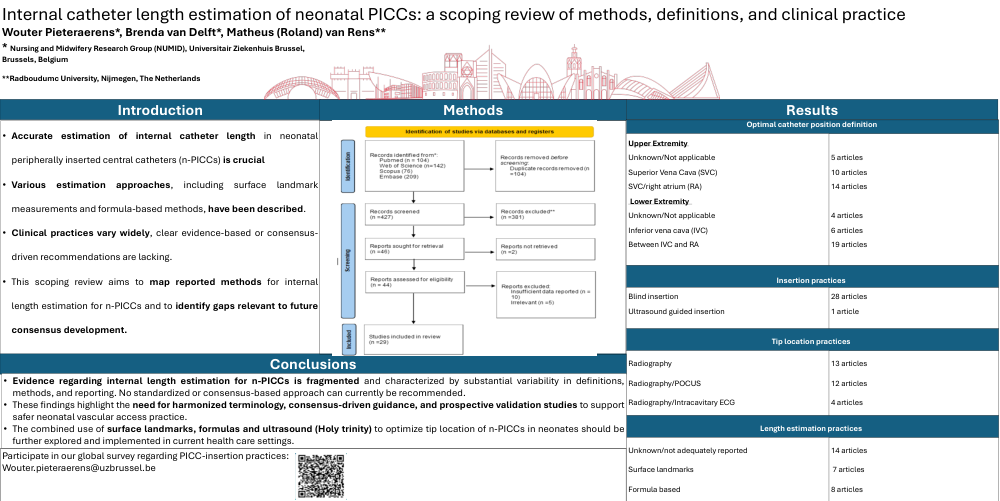
Accurate estimation of internal catheter length in neonatal peripherally inserted central catheters (n-PICCs) is crucial to minimize serious complications such as arrhythmias, cardiac tamponade, and pleural effusion. Various estimation approaches, including surface landmark measurements and formula-based methods, have been described. However, clinical practices vary widely, clear evidence-based or consensus-driven recommendations are lacking. This scoping review aims to map reported methods for internal length estimation for n-PICCs and to identify gaps relevant to future consensus development.
Methods
A scoping review was conducted using a systematic literature search in Embase, PubMed, Scopus, and Web of Science. The search yielded 531 records. After the removal of duplicates, 427 unique articles remained. Following title and abstract screening, 46 full-text articles were assessed for eligibility, of which 29 studies were included. Screening and data extraction were performed independently by three reviewers. Data were synthesized descriptively, focusing on catheter tip position definitions, insertion techniques, tip confirmation methods, and internal length estimation practices.
Results
Substantial heterogeneity was observed across studies. Definitions of optimal catheter tip position varied considerably, with upper extremity insertions most commonly targeting the superior vena cava (n=10) or the cavo-atrial junction (n=14), while lower extremity insertions aimed for the inferior vena cava (n=6) or its junction with the right atrium (n=19). Blind insertion techniques predominated (n=28), with ultrasound-guided insertion only being reported in one study. Tip position was primarily confirmed using radiography alone (n=13) or in combination with point-of-care ultrasound (n=12) or intracavitary ECG (n=4). Internal length estimation methods were inconsistently reported: several studies lacked adequate description (n=14), while others used surface landmark measurements (n=7) or formula-based approaches (n=8).
Reported proportions of correct PICC tip positioning ranged from 35% to 100% across studies, with approaches varying, and several studies reporting higher proportions of correct tip positioning using ultrasound guidance (n=8).
Conclusions
Evidence regarding internal length estimation for n-PICCs is fragmented and characterized by substantial variability in definitions, methods, and reporting. No standardized or consensus-based approach can currently be recommended. These findings highlight the need for harmonized terminology, consensus-driven guidance, and prospective validation studies to support safer neonatal vascular access practice.