193 posters, 19 videos, 10 audios, 3 topics, 28 sessions, 709 authors, 279 institutions
ePostersLive by SciGen Technologies S.A. All rights reserved.
9th World Congress on Vascular Access 2026
15 - 17 April, 2026 | Valencia, Spain
170
<p>SISIPUSH: evaluation of hemoysis and iatrogenic anemia using the push-pull method to obtain blood from pediatric patients with Central Venous Access Devices</p>
Poster Presenter
Part of Topic
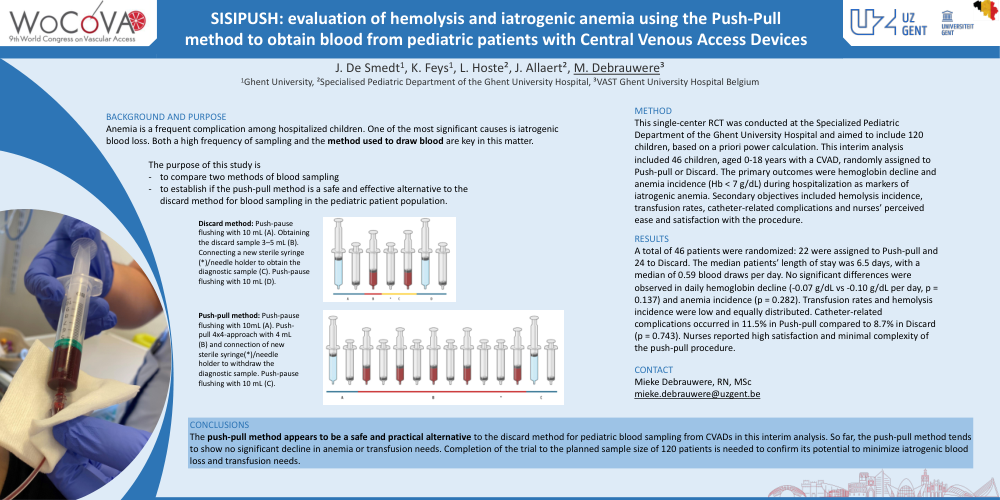
Background. Anemia is a frequent complication among hospitalized children and is associated with clinical consequences. One of the most significant causes is iatrogenic blood loss due to frequent diagnostic blood sampling. The discard method requires withdrawing waste blood to obtain an undiluted blood sample, thereby further increasing the risk of anemia. The push-pull method eliminates this waste blood and has been shown to be safe and reliable in previous studies. However, its clinical applicability remains scarcely studied in pediatric populations.
Methods. A single-center RCT was conducted at the Specialized Pediatric Department of the Ghent University Hospital (Belgium), comparing the safety and effectiveness of the push-pull and discard methods for blood sampling from CVADs. Forty-six children with a CVAD, aged 0-18 years, were randomly assigned to either group. The primary outcomes were hemoglobin decline and anemia incidence (Hb < 7 g/dL) during hospitalization as markers of iatrogenic anemia. Secondary objectives included hemolysis incidence, transfusion rates, catheter-related complications and nurses’ perceived ease and satisfaction of the procedure.
Results. A total of 46 patients were randomized: twenty-two were assigned to the push-pull method and twenty-four to the discard method. The median length of stay of the patients was 6.5 days, with a median of 0.59 blood draws per day. No significant differences were observed between the push-pull and discard group in daily hemoglobin decline (-0.07 g/dL/d vs -0.10 g/dL/d, p = 0.137) and anemia incidence (p = 0.282). Transfusion rates and hemolysis incidence were low and equally distributed. Catheter-related complications occurred in 11.5% in the push-pull group compared to 8.7% in the discard group (p = 0.743). Nurses reported high satisfaction and minimal complexity of the push-pull procedure.
Conclusions. The push-pull method appears to be a safe and practical alternative to the discard method for pediatric blood sampling from CVADs. In this preliminary cohort, the push-pull method tends to show no significant decline in anemia or transfusion needs, and comparable results in safety and complications, sample integrity and user satisfaction. Additional research in larger and more diverse pediatric populations is needed to confirm its potential to minimize iatrogenic blood loss and transfusion needs.