193 posters, 19 videos, 10 audios, 3 topics, 28 sessions, 709 authors, 279 institutions
ePostersLive by SciGen Technologies S.A. All rights reserved.
9th World Congress on Vascular Access 2026
15 - 17 April, 2026 | Valencia, Spain

155
<p>Outside the Protocol: Real-World Challenges in Paediatric Vascular Access</p>
Poster Presenter
Authors
Šárka Havelková, Barbora Šimková, Jana Pavlíčková, Tomáš Vymazal
Affiliations
Part of Topic
OutsidetheProtocol: Real-World Challenges in Paediatric Vascular Access
Background: Motol and Homolka University Hospital, Prague (Czech Republic) is a national tertiary (super-specialised) referral centre. Our paediatric vascular access team was established in 2018 within the Department of Anaesthesiology and Intensive Care Medicine. We deliver>12,000 paediatric anaesthetics annually and place ~900 central venous catheters per year (16% medium-/long-term), following contemporary recommendations (e.g., WoCoVa-endorsed pathways such as RACEVA/RAFAEMA/RAPEVA).
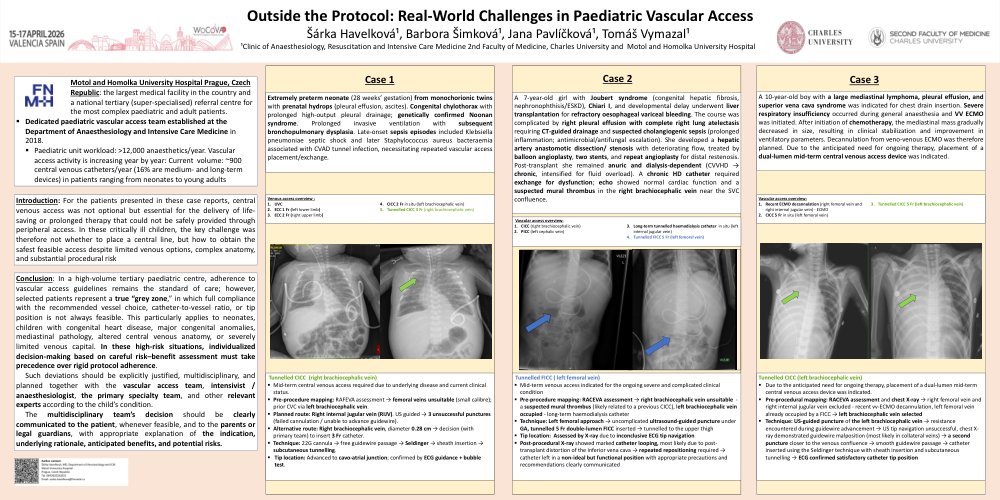
Methods: We report three representative “greyzone” cases in which guideline-based paediatric vascular access required adaptation due to time-critical conditions or anatomy-/physiology-related limitations.
Results: Deviations included: (1) exceeding the recommended catheter-to-vein ratio (>1/3) to achieve necessary access; (2) catheter insertion via the brachiocephalic vein despite a mediastinal mass because no safer route was available; and (3) femoral access with temporary non-ideal tip position due to post–liver transplantation inferior vena cava changes limiting safe advancement. Early complications and clinical rationale are described.
Conclusion: “Greyzone” patients—typically critically ill children with complex histories and limited access options—will continue to require individualised approaches when standard algorithms are not feasible or safe. Structured multidisciplinary decision-making, explicit risk–benefit documentation, and a predefined follow-up plan (function, insertion site and tip surveillance, and early detection of thrombosis/infection) are essential to minimise risk and enable timely intervention.