193 posters, 19 videos, 10 audios, 3 topics, 28 sessions, 714 authors, 278 institutions
ePostersLive by SciGen Technologies S.A. All rights reserved.
9th World Congress on Vascular Access 2026
15 - 17 April, 2026 | Valencia, Spain
139
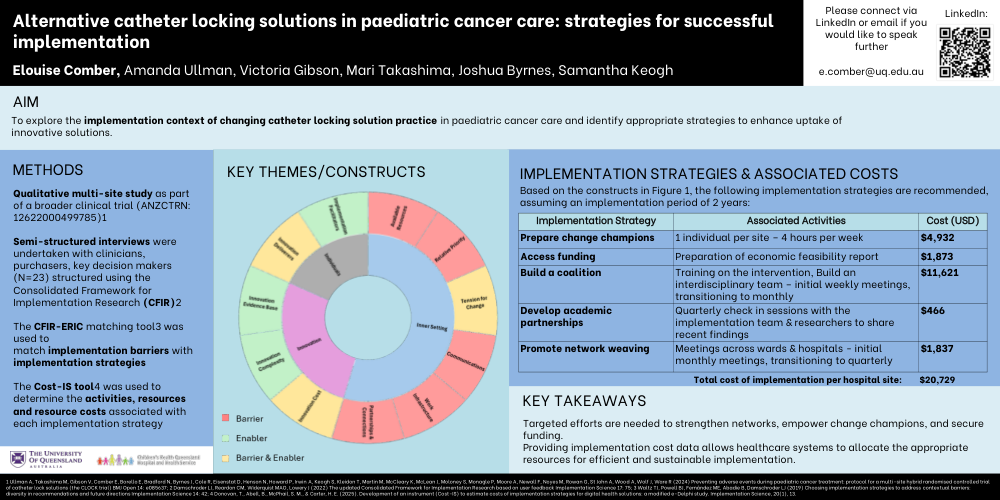
Alternative catheter locking solutions in paediatric cancer care: strategies for successful implementation
Poster Presenter
Authors
Elouise Comber, Amanda Ullman, Victoria Gibson, Mari Takashima, Joshua Byrnes, Samantha Keogh
Affiliations
Centre for Children’s Health Research, Children’s Health Queensland Hospital and Health Service; School of Nursing, Midwifery and Social Work, The University of Queensland, Centre for Children’s Health Research, Children’s Health Queensland Hospital and Health Service, Centre for Applied Health Economics, Griffith University, Centre for Healthcare Transformation, Queensland University of Technology
Part of Topic
Alternative catheter locking solutions in paediatric cancer care: strategies for successful implementation
Aim:
To explore the implementation context of changing catheter locking solution practice in paediatric cancer care and identify appropriate strategies to enhance uptake of innovative solutions.
Methods:
Qualitative multi-site study as part of a broader clinical trial (ANZCTRN: 12622000499785)1
Semi-structured interviews were undertaken with clinicians, purchasers, key decision makers (N=23) structured using the Consolidated Framework for Implementation Research (CFIR)2
The CFIR-ERIC matching tool3 was used to match implementation barriers with implementation strategies
The Cost-IS tool4 was used to determine the activities, resources and resource costs associated with each implementation strategy
Results:
Based on the constructs in Figure 1, the following implementation strategies are recommended, assuming an implementation period of 2 years. Associated activities and costs are also detailed.
1. Prepare Change Champions (USD$4,932) - 1 individual per site – 4 hours per week
2. Access Funding (USD$1,873) - Preparation of economic feasibility report
3. Build a coalition (USD$11,621) - Training on the intervention, Build an interdisciplinary team – initial weekly meetings, transitioning to monthly
4. Develop academic partnerships (USD$466) - Quarterly check in sessions with the implementation team & researchers to share recent findings
5. Promote network weaving (USD$1,837) - Meetings across wards & hospitals - initial monthly meetings, transitioning to quarterly
Total cost of implementation per hospital site: USD$20,729
Key Takeaways:
Targeted efforts are needed to strengthen networks, empower change champions, and secure funding.
Providing implementation cost data allows healthcare systems to allocate the appropriate resources for efficient and sustainable implementation.