193 posters, 19 videos, 10 audios, 3 topics, 28 sessions, 714 authors, 278 institutions
ePostersLive by SciGen Technologies S.A. All rights reserved.
9th World Congress on Vascular Access 2026
15 - 17 April, 2026 | Valencia, Spain

126
Transforming patient safety: a strategic initiative on accelerating national access to peripheral-iv-site monitoring technology for safer care across NHS England
Poster Presenter
Part of Topic
Transforming patient safety: a strategic initiative on accelerating national access to peripheral-intravenous-site monitoring technology for safer care across NHS England
MD Aquino-Guerrero 1 , AB Barton 2
NHS Supply Chain/Frimley Health NHS Trust 1 , Frimley Health NHS Foundation Trusts 2
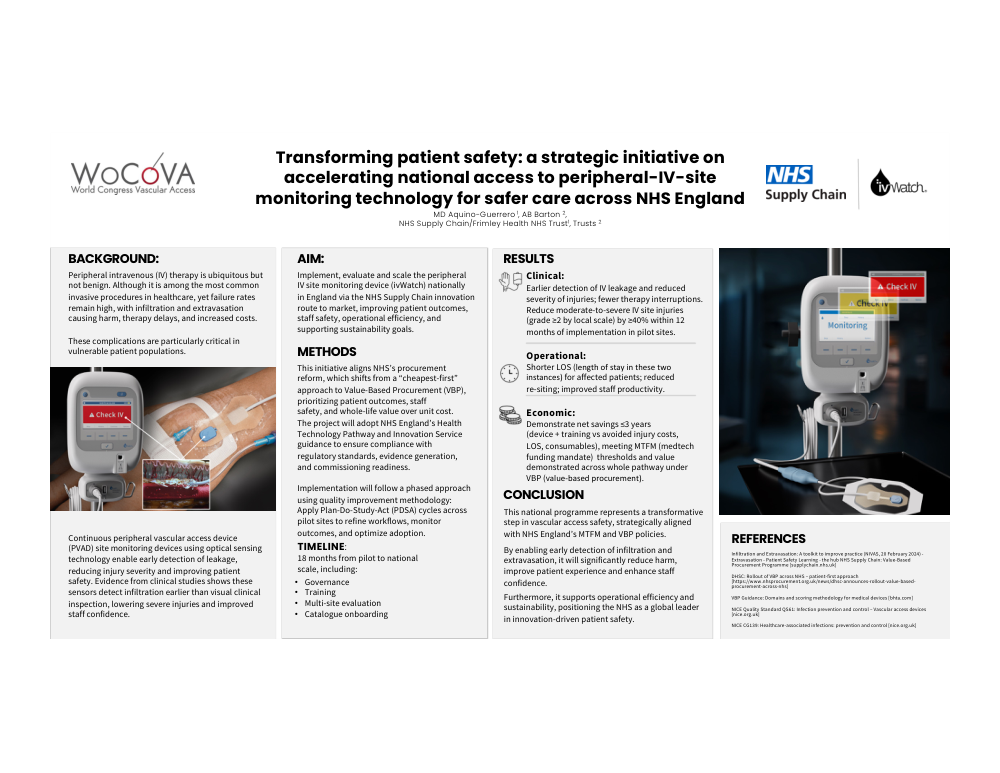
Background: Peripheral intravenous (IV) therapy is ubiquitous but not benign. Although it is among the most common invasive procedures in healthcare, yet failure rates remain high, with infiltration and extravasation causing harm, therapy delays, and increased costs. These complications are particularly critical in vulnerable patient populations. Continuous peripheral vascular access device (PVAD) site monitoring devices using optical sensing technology enable early detection of leakage, reducing injury severity and improving patient safety. Evidence from clinical studies shows these sensors detect infiltration earlier than visual clinical inspection, lowering severe injuries and improved staff confidence.
Aim: Implement, evaluate and scale the peripheral IV site monitoring device (ivWatch) nationally in England via the NHS Supply Chain innovation route to market, improving patient outcomes, staff safety, operational efficiency, and supporting sustainability goals.
Methods: This initiative aligns NHS’s procurement reform, which shifts from a “cheapest-first” approach to Value-Based Procurement (VBP), prioritizing patient outcomes, staff safety, and whole-life value over unit cost. The project will adopt NHS England’s Health Technology Pathway and Innovation Service guidance to ensure compliance with regulatory standards, evidence generation, and commissioning readiness.
Implementation will follow a phased approach using quality improvement methodology: Apply Plan-Do-Study-Act (PDSA) cycles across pilot sites to refine workflows, monitor outcomes, and optimize adoption. Timeline: 18 months from pilot to national scale, including governance, training, multi-site evaluation, and catalogue onboarding.
Results:
Clinical: Earlier detection of IV leakage and reduced severity of injuries; fewer therapy interruptions. Reduce moderate-to-severe IV site injuries (grade ≥2 by local scale) by ≥40% within 12 months of implementation in pilot sites.
Operational: Shorter LOS (length of stay in these two instances) for affected patients; reduced re-siting; improved staff productivity.
Economic: Demonstrate net savings ≤3 years (device + training vs avoided injury costs, LOS, consumables), meeting MTFM (medtech funding mandate) thresholds and value demonstrated across whole pathway under VBP (Value-Based Procurement).
Conclusion:
This national programme represents a transformative step in vascular access safety, strategically aligned with NHS England’s MTFM and VBP policies. By enabling early detection of infiltration and extravasation, it will significantly reduce harm, improve patient experience, and enhance staff confidence. Furthermore, it supports operational efficiency and sustainability, positioning the NHS as a global leader in innovation-driven patient safety.