193 posters, 19 videos, 10 audios, 3 topics, 28 sessions, 714 authors, 278 institutions
ePostersLive by SciGen Technologies S.A. All rights reserved.
9th World Congress on Vascular Access 2026
15 - 17 April, 2026 | Valencia, Spain

124
Development of a new polyurethane catheter for peripheral intravenous catheterization to reduce phlebitis risk: an <em>ex vivo</em> study
Poster Presenter
Part of Topic
Audio
【Introduction】
Peripheral intravenous catheter (PIVC) failure occurs in approximately 33–69% of cases, and phlebitis is a major contributing factor. Endothelial cell loss is considered a key event in phlebitis, and mechanical contact between the catheter and vessel wall is a recognized cause of endothelial injury. Polyurethane is widely used in PIVCs owing to its flexibility; however, recent studies have shown that the stiffness of commercially available polyurethane catheters varies substantially, which may influence phlebitis incidence. These observations suggest that reducing catheter stiffness may mitigate endothelial damage and, in turn, lower the risk of phlebitis. Accordingly, we developed a novel polyurethane catheter with greater flexibility than existing devices and evaluated its performance through ex vivo experiments.
【Methods】
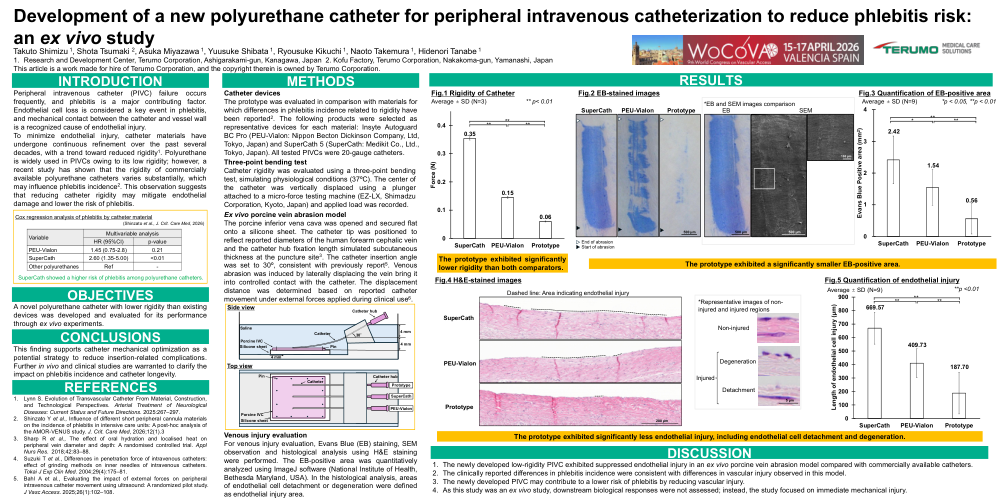
Catheter stiffness was assessed using a three-point bending test (n=3). For ex vivo experiments, PIVCs were attached to porcine veins under conditions simulating human venous catheterization and scraped along the vein. Vein injury was defined as the area of endothelial cell damage and quantified using Evans Blue staining, which selectively penetrates areas of endothelial disruption. The extent of endothelial injury was further evaluated histologically (n = 9). Two commercially available polyurethane catheters [Catheter A (Insyte Autoguard BC Pro; Nippon Becton Dickinson Company, Ltd., Tokyo, Japan) and Catheter B: Supercath5 (Medikit Co., Ltd., Tokyo, Japan)], previously reported to differ in stiffness and phlebitis incidence—were used as controls.
【Results】
The prototype catheter exhibited significantly lower stiffness than the controls (Prototype: 0.060 ± 0.002 N; Catheter A: 0.145 ± 0.003 N; Catheter B: 0.354 ± 0.006 N, P<0.01). The mean Evans Blue-positive area was significantly smaller in the prototype catheter (0.56 ± 0.48 mm²) than Catheter A (1.54 ± 0.56 mm²) and Catheter B (2.42 ± 0.75 mm²; P<0.01). Additionally, the length of endothelial injury was shorter in the prototype (187.70 ± 154.40 μm) than in controls (Catheter A: 409.73 ± 106.45 μm; Catheter B: 669.57 ± 118.04 μm; P<0.01).
【Conclusion】
The newly developed catheter was intended to reduce mechanical injury to the vein wall, which may help lower the risk of phlebitis and catheter failure. Further studies are required to demonstrate its effectiveness in clinical settings.