193 posters, 19 videos, 10 audios, 3 topics, 28 sessions, 714 authors, 278 institutions
ePostersLive by SciGen Technologies S.A. All rights reserved.
9th World Congress on Vascular Access 2026
15 - 17 April, 2026 | Valencia, Spain

120
Algorithms, Tools, Technology and Artificial Intelligence for the Use in Peripheral Intravenous Catheter Vein Selection: A Search for Teaching Methods, Clinical Adoption, Competency and Retention.
Poster Presenter
Authors
Michael Liddelow, Du Huynh, Nikhilesh Bappoo, Peter Carr, Mark Reynolds
Affiliations
University of Western Australia, School of Physics, Maths and Computing, The University of Western Australia, Perth, UWA Centre for Medical Research (affiliated with the Harry Perkins Institute of Medical Research), School of Nursing and Midwifery, University of Galway, School of Physics, Mathematics and Computing, The University of Western Australia
Part of Topic
Algorithms, Tools, Technology and Artificial Intelligence (AI) for the Use in Peripheral Intravenous Catheter Vein Selection for Prolonged Dwell: A Search for Teaching Methods, Clinical Adoption, Competency and Retention
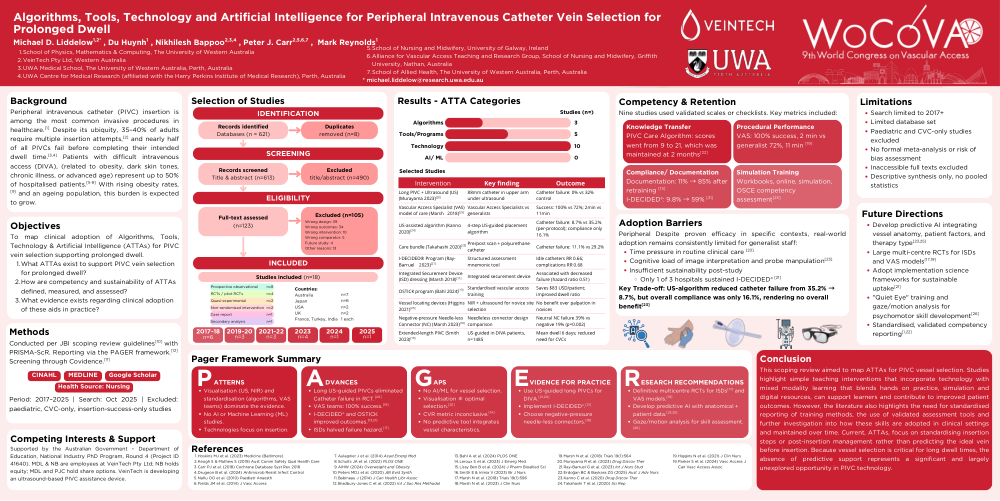
BACKGROUND:
Peripheral intravenous catheter (PIVC) failure remains common, nearly half of all PIVCs experience premature failure before reaching their intended dwell time. Technologies for continuous site monitoring can support earlier detection of device failure and its causes. Reducing these failures is critical for patient outcomes, satisfaction and overall healthcare efficiency.
OBJECTIVE:
To map existing Algorithms, Tools, Technology and Artificial Intelligence (ATTAs) for PIVC vein selection to support prolonged dwell, examined how competency and retention are defined and assessed, and evaluated evidence for clinical feasibility, utility and adoption.
METHODS:
The scoping review was designed in accordance with the Joanna Briggs Institute methodology incorporating the Preferred Reporting Items for Systematic Reviews and Meta-Analyses PRISMA checklist. A deliberate keyword search of CINAHL, MEDLINE Google Scholar, and Health Source: Nursing/Academic Edition databases (October 2025) identified studies from 2017 to 2025 on ATTAs. The reporting followed the PRISMA extension for scoping reviews, with the results and discussion structured according to the Patterns, Advances, Gaps, Evidence for practice, and Research recommendations (PAGER) framework.
RESULTS:
A total of 621 records were found and 123 after title and abstract screening. Following full-text read of 123 studies, 18 studies met the inclusion criteria comprising randomised controlled trials, observational, and quasi-experimental designs. Three related to algorithms, five related to tools, ten related to technology and none referenced artificial intelligence or machine learning for vein selection. Identified ATTAs included ultrasound and near-infrared visualisation, structured decision algorithms, and technologies designed to prolong catheter dwell, such as extended-length PIVCs. Ultrasound-guided insertion of extended-length PIVCs demonstrated high effectiveness, particularly in patients with difficult intravenous access. However, adoption among generalist clinicians was limited due to time pressures and the cognitive demands of image interpretation, and vessel locating devices did not improve performance in novice users.
CONCLUSION:
ATTAs, particularly ultrasound guided long PIVCs and structured algorithms, improve outcomes but are limited by low adoption due to workflow burden and hospital processes. Future development should prioritise low-burden, workflow-integrated ATTAs and predictive artificial intelligence systems to guide optimal vessel selection.
KEYWORDS: PIVC, Vein Selection, Algorithms, Tools, Technology, Artificial Intelligence