140 posters, 10 videos, 15 audios, 20 sessions, 508 authors, 204 institutions
ePostersLive by SciGen Technologies S.A. All rights reserved.
8th World Congress on Vascular Access 2024
April 17 - 19, 2024 | Prague, Czech Republic

96
Efficacy of 4% tetrasodium ethylenediaminetetraacetic acid (T-EDTA) catheter lock solution in cancer patients with venous port and persistent withdrawal occlusion
Poster Presenter
Part of Topic
Introduction
Persistent withdrawal occlusion (PWO) is a specific catheter malfunction characterized by the inability to withdraw blood through the device. The most common cause of PWO in ports is the presence of a fibroblastic sleeve (FS). The method of choice to verify the correct position of the catheter is the echocardiography with the performance of what is known as the bubble test (BT). Mechanical disruption (MD) of the FS can be used to restore aspiration; we have newly focused on the possibility of using T-EDTA for solving PWO. The effectivity of T-EDTA was already proven in preveting occlusions by targeting the triple threat (clots, biofilm, microorganisms).
Methods
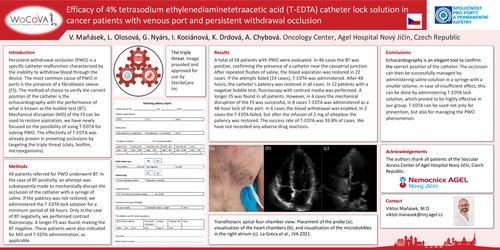
All patients referred for PWO underwent BT. In the case of BT positivity, an attempt was subsequently made to mechanically disrupt the occlusion of the catheter with a syringe of saline. If the patency was not restored, we administered the T-EDTA lock solution for a minimum period of 48 hours. Only in the case of BT negativity, we performed contrast fluoroscopy. A longer FS was found, making the BT negative. These patients were also indicated for MD and T-EDTA administration, as applicable.
Results
A total of 58 patients with PWO were evaluated. In 46 cases the BT was positive, confirming the presence of a catheter near the cavoatrial junction. After repeated flushes of saline, the blood aspiration was restored in 22 cases. If the atempts failed (24 cases), T-EDTA was administered. After 48 hours, the catheter‘s patency was restored in all cases. In 12 patients with a negative bubble test, fluoroscopy with contrast media was performed. A longer FS was found in all patients. However, in 4 cases the mechanical disruption of the FS was successful, in 8 cases T-EDTA was administered as a 48-hour lock of the port. In 6 cases the blood withdrawal was enabled. In 2 cases the T-EDTA failed, but after the infusion of 2 mg of alteplase the patency was restored. The success rate of T-EDTA was 93.8% of cases. We have not recorded any adverse drug reactions.
Conclusions
Echocardiography is an elegant tool to confirm the correct position of the catheter. The occlusion can then be successfully managed by administering saline solution in a syringe with a smaller volume; in case of insufficient effect, this can be done by administering T-EDTA lock solution, which proved to be highly effective in our group. T-EDTA can be used not only for prevention, but also for managing the PWO phenomenon.