140 posters, 10 videos, 15 audios, 20 sessions, 508 authors, 204 institutions
ePostersLive by SciGen Technologies S.A. All rights reserved.
8th World Congress on Vascular Access 2024
April 17 - 19, 2024 | Prague, Czech Republic

102
Difficult removal of the venous port system - single center experience.
Poster Presenter
Authors
Vendelín Chovanec, David Astapenko, Peter Priester, Pavel Žák, Jan Raupach, Ondřej Renc, Zdeněk Bělorádek, Pavlina Vyletová
Affiliations
Radiology Clinic, University Hradec Králové, Dept. of Radiology, University Hospital and Faculty of Medicine in Hradec Kralove, Charles University, Dept of Anesthesiology and Intensive Care Medicine, University Hospital and Faculty of Medicine in Hradec Kralove, Charles University, Dept. of Oncology and Radiotherapy, University Hospital and Faculty of Medicine in Hradec Kralove, Charles University, 4th Dept of Internal Medicine - Hematology, University Hospital and Faculty of Medicine in Hradec Kralove, Charles University, Dept. of Radiology, University Hospital, Hradec Kralove
Part of Topic
Difficult removal of the venous port system – single center experience
Chovanec V.1, Astapenko D. 2, Priester P. 3, Žák P. 4, Raupach J. 1, Renc O. 1, Bělobrádek Z. 1 , Vyletová P. 1
1Dept. of Radiology, 2 Dept. of Anesthesiology, 3Dept. of Oncology, 4 4th Dept. of Internal Medicine - Hematology, University Hospital in Hradec Kralove, Czech Republic
Introduction:
Central venous port system allows long-term safe administration of chemotherapy. Reasons for portcatheter removal are complications (infection, thrombosis, dislocation, malfuction and skin erosion) and the end of therapy. Removal procedure is usually uncomplicated but sometimes can be difficult. The goal of our study was to evaluate the experience with difficult extraction of portcatheters during 9 years in a retrospective single-center study.
Material and Methods:
From January 2014 to November 2023, we removed 1577 intravenous portcatheters. Difficult catheter extraction was defined as a removal by using a guidewire, dissection with sheath, and transvenous extraction with a snare. Thirthy-four extractions (2,2 %) were classified as difficult. There were 15 males and 19 females with a median age of 67 years (41 – 82 years) in this group. The primary diagnosis for implantation was malignancy in 33 patients and asthma bronchiale in one patient. The jugular vein was cannulated in 14 patients and the axillary vein in 19 patients. One patient had a port inserted through the left basilic vein.
Results:
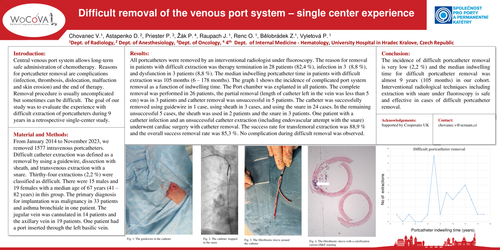
All portcatheters were removed by an interventional radiologist under fluoroscopy. The reason for removal in patients with difficult extraction was therapy termination in 28 patients (82,4 %), infection in 3 (8,8 %), and dysfunction in 3 patients (8,8 %). The median indwelling portcatheter time in patients with difficult extraction was 105 months (6 – 178 months). The graph 1 shows the incidence of complicated port system removal as a function of indwelling time. The Port chamber was explanted in all patients. The complete removal was performed in 26 patients, the partial removal (length of catheter left in the vein was less than 5 cm) was in 3 patients and catheter removal was unsuccessful in 5 patients. The catheter was successfully removed using guidewire in 1 case, using sheath in 3 cases, and using the snare in 24 cases. In the remaining unsuccessful 5 cases, the sheath was used in 2 patients and the snare in 3 patients. One patient with a catheter infection and an unsuccessful catheter extraction (including endovascular attempt with the snare) underwent cardiac surgery with catheter removal. The success rate for transfemoral extraction was 88,9 % and the overall success removal rate was 85,3 %. No complication during difficult removal was observed.
Conclusion:
The incidence of difficult portcatheter removal is very low (2,2 %) and the median indwelling time for difficult portcatheter removal was almost 9 years (105 months) in our cohort. Interventional radiological techniques including extraction with snare under fluoroscopy is safe and effective in cases of difficult portcatheter removal.
Acknowledgements: Supported by Cooperatio UK
Contact: chovanec.v@seznam.cz