140 posters, 10 videos, 15 audios, 20 sessions, 508 authors, 204 institutions
ePostersLive by SciGen Technologies S.A. All rights reserved.
8th World Congress on Vascular Access 2024
April 17 - 19, 2024 | Prague, Czech Republic

89
Peripherally inserted central catheter as a safe option for patients with acute promyelocytic leukemia
Poster Presenter
Part of Topic
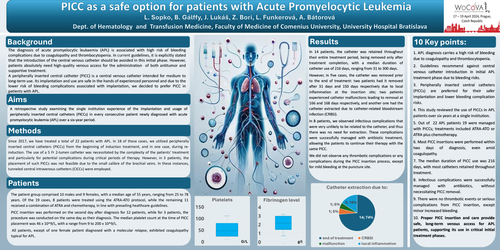
PICC as a safe option for patients with Acute Promyelocytic Leukemia
Background:
The diagnosis of acute promyelocytic leukaemia (APL) is associated with high risk of bleeding complications due to coagulopathy and thrombocytopenia. In current guidelines, it is explicitly stated that the introduction of the central venous catheter should be avoided in this initial phase. However, patients absolutely need high-quality venous access for the administration of both antitumor and supportive treatment.
A peripherally inserted central catheter (PICC) is a central venous catheter intended for medium to long-term use. Its implantation and use are safe in the hands of experienced personnel and due to the lower risk of bleeding complications associated with implantation, we decided to prefer PICC in patients with APL.
Aims: A retrospective study examining the single institution experience of the implantation and usage of peripherally inserted central catheters (PICCs) in every consecutive patient newly diagnosed with acute promyelocytic leukemia (APL) over a six-year period.
Methods: Since 2017, wehavetreated a total of 22 patientswith APL. In 18 of thesecases, weutilizedperipherallyinsertedcentralcatheters (PICCs) fromthebeginning of inductiontreatment, and in onecase, during re-induction. Theuse of a 5 Fr 2-lumen catheterwasnecessitated by thecomplexity of thepatients' treatment and particularlyforpotentialcomplicationsduringcriticalperiods of therapy. However, in 3 patients, theplacement of suchPICCswasnotfeasibledue to thesmallcalibre of thebrachialveins. In theseinstances, tunneledcentralintravenouscatheters (CICCs) wereemployed
Patients: The patient group comprised 10 males and 9 females, with a median age of 55 years, ranging from 25 to 78 years. Of the 19 cases, 8 patients were treated using the ATRA-ATO protocol, while the remaining 11 received a combination of ATRA and chemotherapy, in line with prevailing healthcare guidelines.
PICC insertion was performed on the second day after diagnosis for 12 patients, while for 3 patients, the procedure was conducted on the same day as their diagnosis. The median platelet count at the time of PICC placement was 46 x 10^9/L, with a range from 9 to 200 x 10^9/L.
All patients, except of one female patient diagnosed with a molecular relapse, exhibited coagulopathy typical for APL.
Results: In 14 patients, the catheter was retained throughout their entire treatment period, being removed only after treatment completion, with a median duration of catheter use of 216 days, ranging from 31 to 300 days.
However, in five cases, the catheter was removed prior to the end of treatment: two patients had it removed after 31 days and 150 days respectively due to local inflammation at the insertion site; two patients experienced catheter malfunctions leading to removal at 166 and 168 days respectively, and another one had the catheter extracted due to catheter-related bloodstream infection (CRBSI).
In 8 patients, we observed infectious complications that were very unlikely to be related to the catheter, and thus there was no need for extraction. These complications were successfully managed with antibiotic treatment, allowing the patients to continue their therapy with the same PICC.
We did not observe any thrombotic complications or any complications during the PICC insertion process, except for mild bleeding at the puncture site.
10 Key Points:
1. APL diagnosis carries a high risk of bleeding due to coagulopathy and thrombocytopenia.
2. Guidelines recommend against central venous catheter introduction in initial APL treatment phase due to bleeding risks.
3. Peripherally inserted central catheters (PICCs) are preferred for their safer implantation and lower bleeding complication risks.
4. This study reviewed the use of PICCs in APL patients over six years at a single institution.
5. Out of 22 APL patients 19 were managed with PICCs; treatments included ATRA-ATO or ATRA plus chemotherapy.
6. Most PICC insertions were performed within two days of diagnosis, even amid coagulopathy.
7. The median duration of PICC use was 216 days, with most catheters retained throughout treatment.
8. Infectious complications were successfully managed with antibiotics, without necessitating PICC removal.
9. There were no thrombotic events or serious complications from PICC insertion, except minor increased bleeding.
10. Proper PICC insertion and care provide safe, long-term venous access for APL patients, supporting its use in critical initial treatment phases.