140 posters, 10 videos, 15 audios, 20 sessions, 508 authors, 204 institutions
ePostersLive by SciGen Technologies S.A. All rights reserved.
8th World Congress on Vascular Access 2024
April 17 - 19, 2024 | Prague, Czech Republic

83
Factors influencing chemoport-associated thrombosis: a retrospective single-center study
Part of Topic
Background and objective: chemoport-related thrombosis (CRT) is a serious complication that causes disease and disrupts the administration of intravenous cancer treatment. The purpose of this study is to find factors associated with the occurrence CRT.
Methods: This single-center retrospective study included 1690 cases of chemoport implantation between January 2017 and December 2020.
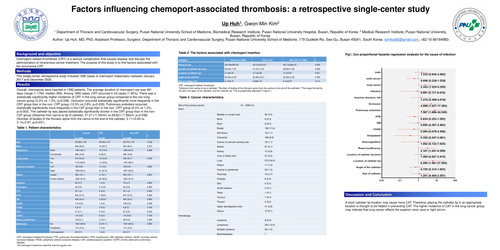
Results: Overall, chemoports were inserted in 1582 patients. The average duration of chemoport use was 481 days (range 1–1794, median 309). Among 1690 cases, CRT occurred in 24 cases (1.42%). There was a statistically significantly higher incidence of CRT in the lung cancer group compared to the non-lung cancer group (2.3% vs. 1.0%; p<0.036). Occlusion occurred statistically significantly more frequently in the CRT group than in the non- CRT group (12.5% vs 2.8%; p<0.030). Pulmonary embolism occurred statistically significantly more frequently in the CAT group than in the non- CRT group (8.3% vs 1.2%; p<0.002). The catheter tip was placed statistically significantly shorter in the CRT group than in the non-CAT group (Distance from carina to tip of catheter, 21.21±11.55mm vs 28.62±17.39mm; p<0.038) (Number of bodies of the thoracic spine from the carina to the end of the catheter, 2.71±0.69 vs 3.14±0.97; p<0.031).
Conclusions: A short catheter tip location may cause more CRT. Therefore, placing the catheter tip in an appropriate location is thought to be helpful in preventing CRT. The higher incidence of CRT in the lung cancer group may indicate that lung cancer affects the superior vena cava or right atrium.