140 posters, 10 videos, 15 audios, 20 sessions, 508 authors, 204 institutions
ePostersLive by SciGen Technologies S.A. All rights reserved.
8th World Congress on Vascular Access 2024
April 17 - 19, 2024 | Prague, Czech Republic

82
Vascular access device type for systemic anti-cancer therapies in cancer patients', the last 10 years. A scoping review
Poster Presenter
Part of Topic
Background and Objectives
Globally, the number of patients with cancer is increasing; from 9.8 million in 2018 to 15 million in 2040, there will be a 53% increase in the number of people requiring first-line chemotherapy1, with 75% of those treatments being given intravenously2. Numerous invasive vascular access procedures for intravenous therapy and clinical diagnostics are commonplace for cancer patients3.
The aim of the study was to identify the different kinds of data that support the use of vascular access devices (VADs) to provide systemic anti-cancer therapy (SACT) to cancer patients
Methods
To determine the kinds of VADs used for SACT, we employed the JBI scoping review process. We also employed a targeted search strategy, incorporating English-language publications from 2012 to 2022. Our approach to reporting and analysing scoping studies was based on the Patterns, Advances, Gaps, Evidence of Practice, and Research Recommendations (PAGER) framework4.
Results
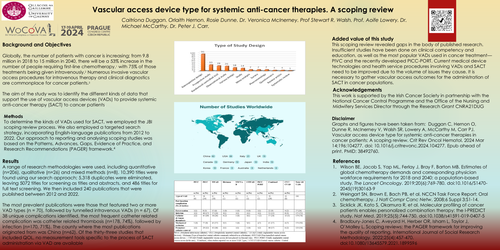
A range of research methodologies were used, including quantitative (n=206), qualitative (n=26) and mixed methods (n=8). 10,390 titles were found using our search approach; 5,318 duplicates were eliminated, leaving 5072 titles for screening as titles and abstracts, and 486 titles for full text screening. We then included 240 publications that were published between 2012 and 2022. The most prevalent publications were those that featured two or more VAD types (n = 70), followed by tunnelled intravenous VADs (n = 67). Of 38 unique complications identified, the most frequent catheter related complication was catheter related thrombosis (n=178, 74%), followed by infection (n=170, 71%). The county where the most publications originated from was China (n=62) . Of the thirty three studies that included QOL no measurement tools specific to the process of SACT administration via VAD are available
Added value of this study
This scoping review revealed gaps in the body of published research. Insufficient studies have been done on clinical competency and education, as well as the most popular VADs used in cancer treatment—PIVC and the recently developed PICC-PORT. Current medical device technologies and health service procedures involving VADs and SACT need to be improved due to the volume of issues they cause. It is necessary to gather vascular access outcomes for the administration of SACT in cancer populations
Acknowledgements
This work is supported by the Irish Cancer Society in partnership with the National Cancer Control Programme and the Office of the Nursing and Midwifery Services Director through the Research Grant CNRA21DUG
Disclaimer
Graphs and figures have been taken from Duggan C, Hernon O, Dunne R, McInerney V, Walsh SR, Lowery A, McCarthy M, Carr PJ. Vascular access device type for systemic anti-cancer therapies in cancer patients: A scoping review. Crit Rev Oncol Hematol. 2024 Mar 14;196:104277. doi: 10.1016/j.critrevonc.2024.104277. Epub ahead of print. PMID: 38492760
References