140 posters, 10 videos, 15 audios, 20 sessions, 508 authors, 204 institutions
ePostersLive by SciGen Technologies S.A. All rights reserved.
8th World Congress on Vascular Access 2024
April 17 - 19, 2024 | Prague, Czech Republic

81
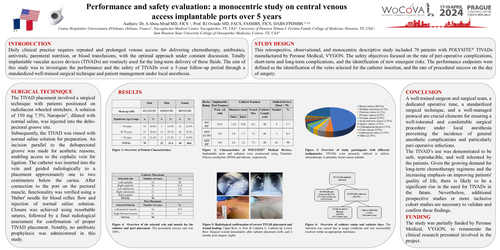
Performance and safety evaluation: a monocentric study on central venous access implantable ports over 5 years
Poster Presenter
Part of Topic
INTRODUCTION
Daily clinical practice requires repeated and prolonged venous access for delivering chemotherapy, antibiotics, antivirals, parenteral nutrition, or blood transfusions, with the optimal approach under constant discussion. Totally implantable vascular access devices (TIVADs) are routinely used for the long-term delivery of these fluids. The aim of this study was to investigate the performance and the safety of TIVADs over a 5-year follow-up period through a standardized well-trained surgical technique and patient management under local anesthesia.
STUDY DESIGN
This retrospective, observational, and monocentric descriptive study included 70 patients with POLYSITE® TIVADs manufactured by Perouse Medical, VYGON. The safety objectives focused on the rate of peri-operative complications, short-term and long-term complications, and the identification of new emergent risks. The performance endpoints were defined as the identification of the veins selected for the catheter insertion, and the rate of procedural success on the day of surgery.
SURGICAL TECHNIQUE
The TIVAD placement involved a surgical technique with patients positioned on radiolucent wheeled stretchers. A solution of 150 mg 7% Naropein©, diluted with normal saline, was injected into the delto-pectoral groove site. Subsequently, the TIVAD was rinsed with normal saline solution for preparation. An incision parallel to the deltopectoral groove was made for aesthetic reasons, enabling access to the cephalic vein for ligation. The catheter was inserted into the vein and guided radiologically to a placement approximately one to two centimeters below the carina. After connection to the port on the pectoral muscle, functionality was verified using a 'Huber' needle for blood reflux flow and injection of normal saline solution. Closure was achieved using resorbable sutures, followed by a final radiological assessment for confirmation of proper TIVAD placement. Notably, no antibiotic prophylaxis was administered in this study.
CONCLUSION
A well-trained surgeon and surgical team, a dedicated operative time, a standardized surgical technique, and a well-managed protocol are crucial elements for ensuring a well-tolerated and comfortable surgical procedure under local anesthesia preventing the incidence of general anesthetic complications and particularly peri-operative infections. The TIVAD’s use was demonstrated to be safe, reproducible, and well tolerated by the patients. Given the growing demand for long-term chemotherapy regimens and the increasing emphasis on improving patients' quality of life, there is likely to be a significant rise in the need for TIVADs in the future. Nevertheless, additional prospective studies or more inclusive cohort studies are necessary to validate and confirm these findings.
FUNDING
The study was partially funded by Perouse Medical, VYGON, to remunerate the clinical research personnel involved in the project.