140 posters, 10 videos, 15 audios, 20 sessions, 508 authors, 204 institutions
ePostersLive by SciGen Technologies S.A. All rights reserved.
8th World Congress on Vascular Access 2024
April 17 - 19, 2024 | Prague, Czech Republic

73
Improvements in the care and management of the multiple therapy patient: preliminary results of pilot study
Part of Topic
Video
Improvements in the care and management of the multiple therapy patient: preliminary results of pilot study
AUTHORS: Ferraz-Torres M.1,2,3, Corcuera-Martinez MI.1, Martinez-García O 1, Jimenez-Loygorri A 5, Rodriguez A 6
INSTITUTION: 1 Hospital Universitario de Navarra. 2 Universidad pública de Navarra. 3 IDisNa 4 Darwin Biomedical 5 Osakidetza.
background:
Intravenous Therapy is the most applied treatment in patients with hospital admissions. This therapy and the management of vascular accesses are in numerous occasions the reason for the appearance of Adverse Events that derive in accidents causing the increase of the patient's admission time.
In Intensive Care Units and surgical areas, the critical patient is in a state that makes him/her prone to require Intravenous Therapy in a higher proportion and in a constant manner, so the healthcare professional performs a continuous manipulation of vascular accesses and their connections during the entire period of admission of such patient, being even higher the risk of complications .
method:
Prospective inferential study during 6 months in an intensive care area of a tertiary hospital in Spain. A total of 33 variables were collected, distributed into sociodemographic data, dependent study variables delimited by level of safety, usability and satisfaction with the handling of the new device and independent variables marked by different categories.
results:
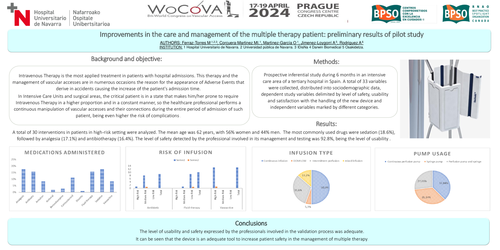
A total of 30 interventions in patients in high-risk setting were analyzed. The mean age was 62 years, with 56% women and 44% men. The most commonly used drugs were sedation (18.6%), followed by analgesia (17.1%) and antibiotherapy (16.4%). The level of safety detected by the professional involved in its management and testing was 92.8%, being the level of usability 89.6%.
Conclusions
The level of usability and safety expressed by the professionals involved in the validation process was adequate.
It can be seen that the device is an adequate tool to increase patient safety in the management of multiple therapy.