140 posters, 10 videos, 15 audios, 20 sessions, 508 authors, 204 institutions
ePostersLive by SciGen Technologies S.A. All rights reserved.
8th World Congress on Vascular Access 2024
April 17 - 19, 2024 | Prague, Czech Republic

63
Clinical practice of introducing and care of vascular access in Anesthesiology and Intensive Care Medicine - a national questionnaire study in the Czech Republic
Poster Presenter
Authors
David Astapenko, Tomas Brozek, Jakub Kletecka, Viktor Manasek, Vendelín Chovanec
Affiliations
Radiology Clinic, University Hradec Králové, Dept. of Anesthesiology and Intensive Care Medicine, University Hospital Hradec Kralove, Czech Republic, Dept. of Anesthesiology and Intensive Care Medicine, General University Hospital, Prague, Czech Republic, Dept. of Anesthesiology and Intensive Care Medicine, University Hospital Plzen, Czech Republic, Dept. of Oncology, Agel Hospital Novy Jicin, Czech Republic
Part of Topic
Introduction:
Vascular access is an integral part of patient care in anesthesiology and intensive care medicine. There is enormous variability in the way of introduction and care about vascular catheters in the light of relatively recently published protocols (e.g., SIC protocol, RACEVA protocol). Our goal was to describe the practices and habits in intensive care units of anesthesiology departments in the Czech Republic in an online questionnaire.
Methods:
A virtual questionnaire with 27 questions was developed. Covered areas of the survey were: the hospital type, types of catheters used, nurse practice, cannulation site selection, details of the cannulation technique, and catheter-related complications.
Results:
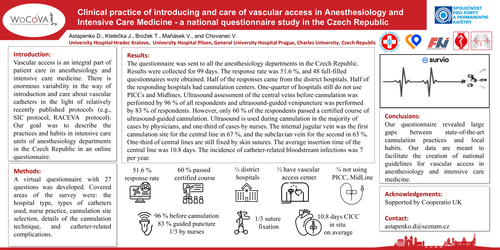
The questionnaire was sent to all the anesthesiology departments in the Czech Republic. Results were collected for 99 days. The response rate was 51.6 %, and 48 full-filled questionnaires were obtained. Half of the responses came from the district hospitals. Half of the responding hospitals had cannulation centers. One-quarter of hospitals still do not use PICCs and Midlines. Ultrasound assessment of the central veins before cannulation was performed by 96 % of all respondents and ultrasound-guided venipuncture was performed by 83 % of respondents. However, only 60 % of the respondents passed a certified course of ultrasound-guided cannulation. Ultrasound is used during cannulation in the majority of cases by physicians, and one-third of cases by nurses. The internal jugular vein was the first cannulation site for the central line in 67 %, and the subclavian vein for the second in 63 %. One-third of central lines are still fixed by skin sutures. The average insertion time of the central line was 10.8 days. The incidence of catheter-related bloodstream infections was 7 per year.
Conclusions:
Our questionnaire revealed large gaps between state-of-the-art cannulation practices and local habits. Our data are meant to facilitate the creation of national guidelines for vascular access in anesthesiology and intensive care medicine.