140 posters, 10 videos, 15 audios, 20 sessions, 508 authors, 204 institutions
ePostersLive by SciGen Technologies S.A. All rights reserved.
8th World Congress on Vascular Access 2024
April 17 - 19, 2024 | Prague, Czech Republic

61
Feasibility and appropriateness of PICCs among cancer patient with chronic kidney disease observed over a two-year period
Poster Presenter
Authors
Affiliations
Part of Topic
Feasibility and appropriateness of PICCs among cancer patients with chronic kidney disease observed over a two-year period
Introduction
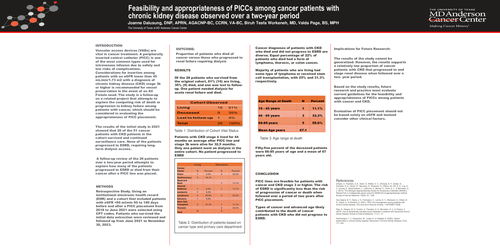
Vascular access devices (VADs) are vital in cancer treatment. A peripherally inserted central catheter (PICC) is one of the most common types used for intravenous infusion due to its safety and low risk of complications. Considerations for insertion among patients with an eGFR lower than 45 mL/min/1.73 m2 with a diagnosis of chronic kidney disease (CKD) stage 3b or higher is recommended for vessel preservation in the event of an AV Fistula need. The study is a follow-up on a related project that attempts to explore the competing risk of death or progression to kidney failure among patients with cancer, which should be considered in evaluating the appropriateness of PICC placement. The results of the initial study in 2021 showed that 26 of the 51 cancer patients with CKD patients in the cohort survived and continued surveillance care. None of the patients progressed to ESRD, requiring long-term dialysis access. A follow-up review of the 26 patients over a two-year period attempts to explore how many of the patients progressed to ESRD or died from their cancer after a PICC line was placed.
METHODS Retrospective Study. Using an institutional electronic health record (EHR) and a cohort that included patients with eGFR <60 ml/min 90 to 180 days before and after a PICC placement from 2018 to June 2021 were selected using CPT codes. Patients who survived the initial data extraction were reviewed and followed up from June 2021 to November 30, 2023.
OUTCOME: Proportion of patients who died of cancer versus those who progressed to renal failure requiring dialysis
RESULTS Of the 26 patients who survived from the original cohort, 61% (16) are living, 35% (9) died, and one was lost to follow-up. One patient needed dialysis for acute renal failure and died.
Patients with CKD stage 4 lived for 44 months on average after PICC line, and stage 3b were alive for 32.5 months. Only one patient went on dialysis in the entire cohort. No patient progressed to ESRD.
Cancer diagnoses of patients with CKD who died and did not progress to ESRD are diverse. Equal percentage of 22% of patients who died had a form of lymphoma, thoracic, or colon cancer. Majority of patients who are living had some type of lymphoma or received stem cell transplantation, with 25% and 21.3% respectively.
Fifty-five percent of the deceased patients were on the 66-85 years of age and a mean of 67 years old. CONCLUSION PICC lines are feasible for patients with cancer and CKD stage 3 or higher. The risk of ESRD is significantly less than the risk of progression of cancer or death when followed over a period of two years after PICC placement. Types of cancer and advanced age likely contributed to the death of cancer patients with CKD who did not progress to ESRD.
CONCLUSION PICC lines are feasible for patients with cancer and CKD stage 3 or higher. The risk of ESRD is significantly less than the risk of progression of cancer or death when followed over a period of two years after PICC placement. Types of cancer and advanced age likely contributed to the death of cancer patients with CKD who did not progress to ESRD.
Implications for Future Research: The results of the study cannot be generalized. However, the results supports a relatively low proportion of cancer patients with CKD that progressed to end stage renal disease when followed over a two- year period. Based on the study results, future research and practice must evaluate current guidelines for the feasibility and appropriateness of PICCs among patients with cancer and CKD. Evaluation of PICC placement should not be based solely on eGFR and instead consider other clinical factors.