140 posters, 10 videos, 15 audios, 20 sessions, 508 authors, 204 institutions
ePostersLive by SciGen Technologies S.A. All rights reserved.
8th World Congress on Vascular Access 2024
April 17 - 19, 2024 | Prague, Czech Republic

60
Feasibility and safety of peripherally inserted central catheters in patients with acute leukemias and myelodysplastic neoplasms – a single center experience.
Part of Topic
Feasibility and safety of peripherally inserted central catheters in patients with acute leukemias and myelodysplastic neoplasms – a single center experience.
Background
Nowadays, PICC is a standard intravascular access used in patients with solid tumors, lymphomas, and other non-oncological diseases requiring medium to long-term central venous access. However, PICC applicability in patients with acute leukemias (AL) and myelodysplastic neoplasms (MDS) can be sometimes controversial due to specific characteristics of this patient group, such as severe cellular immunodeficiency, frequent infections or a tendency towards bleeding.
Objectives and methods
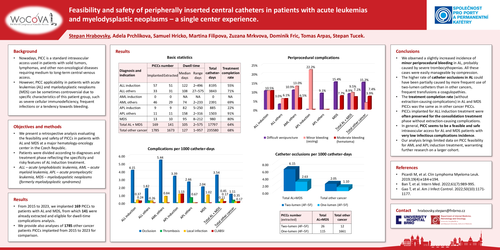
We present a retrospective analysis evaluating the feasibility and safety of PICCs in patients with AL and MDS at a major hematology-oncology center in the Czech Republic. Patients were divided according to diagnoses and treatment phase reflecting the specificity and risky features of AL induction treatment.
(ALL – acute lymphoblastic leukemia, AML – acute myeloid leukemia, APL – acute promyelocytic leukemia, MDS – myelodyspalstic neoplasms (formerly myelodysplastic syndromes))
Results
From 2015 to 2023, we implanted 169 PICCs to patients with AL and MDS, from which 141 were already extracted and eligible for dwell-time complications analysis. We provide also analyses of 1785 other cancer patients PICCs implanted from 2015 to 2023 for comparison.
Conclusions
We observed a slightly increased incidence of minor periprocedural bleeding in AL, probably caused by severe trombocythopenias. All these cases were easily manageable by compression. The higher rate of catheter occlusions in AL could have been partially caused by more frequent use of two-lumen catheters than in other cancers, frequent transfusions a coagulopathies. The treatment completion rate (without extraction-causing complications) in AL and MDS PICCs was the same as in other cancer PICCs. PICCs implanted for ALL induction treatment were often preserved for the consolidation treatment phase without extraction-causing complications. In general, PICC seems to be a feasible and safe intravascular access for AL and MDS patients with very low infectious complications incidence. Our analysis brings limited data on PICC feasibility for AML and APL induction treatment, warranting further research on a larger cohort.