140 posters, 10 videos, 15 audios, 20 sessions, 508 authors, 204 institutions
ePostersLive by SciGen Technologies S.A. All rights reserved.
8th World Congress on Vascular Access 2024
April 17 - 19, 2024 | Prague, Czech Republic

51
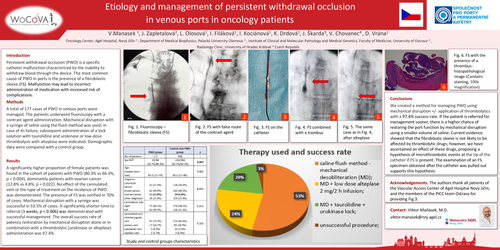
Etiology and management of persistent withdrawal occlusion in venous ports in oncology patients
Poster Presenter
Authors
Viktor Manasek, Jana Zapletalová, Ludmila Olosová, Ivana Filáková, Iveta Kociánová, Karolína Drdová, Jozef Škarda, Vendelín Chovanec, David Vrána
Affiliations
Oncology Center, Agel Hospital, Nový Jičín, Department of Medical Biophysics, Palacký University Olomouc, Institute of Clinical and Molecular Pathology and Medical Genetics, Faculty of medicine, University of Ostrava, Radiology Clinic, University Hradec Králové
Part of Topic
Introduction
Persistent withdrawal occlusion (PWO) is a specific catheter malfunction characterized by the inability to withdraw blood through the device. The most common cause of PWO in ports is the presence of a fibroblastic sleeve (FS). Malfunction may lead to incorrect administration of medication with increased risk of complications.
Methods
A total of 177 cases of PWO in venous ports were managed. The patients underwent fluoroscopy with a contrast agent administration. Mechanical disruption with a syringe of saline using the flush method was used; in case of its failure, subsequent administration of a lock solution with taurolidine and urokinase or low-dose thrombolysis with alteplase were indicated. Demographic data were compared with a control group.
Results
A significantly higher proportion of female patients was found in the cohort of patients with PWO (80.3% vs 66.3%, p = 0.004), dominantly patients with ovarian cancer (12.8% vs 4.8%, p = 0.022). No effect of the cannulated vein or the type of treatment on the incidence of PWO was demonstrated. The presence of FS was verified in 70% of cases. Mechanical disruption with a syringe was successful in 53.5% of cases. A significantly shorter time to referral (3 weeks, p = 0.006) was demonstrated with successful management. The overall success rate of patency restoration by mechanical disruption alone or in combination with a thrombolytic (urokinase or alteplase) administration was 97.4%.
Conclusions
We created a method for managing PWO using mechanical disruption +/- application of thrombolytics with a 97.4% success rate. If the patient is referred for management sooner, there is a higher chance of restoring the port function by mechanical disruption using a smaller volume of saline. Current evidence showed that the fibroblastic sleeve is not likely to be affected by thrombolytic drugs; however, we have ascertained an effect of these drugs, proposing a hypothesis of microthrombotic events at the tip of the catheter if FS is present. The examination of an FS specimen obtained after the catheter was pulled out supports this hypothesis.