140 posters, 10 videos, 15 audios, 20 sessions, 508 authors, 204 institutions
ePostersLive by SciGen Technologies S.A. All rights reserved.
8th World Congress on Vascular Access 2024
April 17 - 19, 2024 | Prague, Czech Republic

45
Does the longer dwell time of peripherally inserted central catheters increase the risk of bloodstream infection?
Poster Presenter
Authors
Affiliations
Part of Topic
Does the longer dwell time of peripherally inserted central catheters increase the risk of bloodstream infection?
Primary Author: Rose McGuire
Secondary Author & Affiliation: Vascular Access Team, The Royal Marsden Hospital NHS FT
Introduction
Peripherally inserted central catheters (PICC) are frequently used to provide long-term venous access for administering different types of intravenous therapy. Studies have shown that the risks of catheter-related bloodstream infection (CR-BSI) increase with longer dwell time for vascular access devices (VADs). This abstract aims to evaluate a small cohort of PICCs to determine whether longer dwell time increases the risks of infection or contributes to vessel health and preservation (VHP), patient satisfaction, and cost avoidance.
Method
Between May 2022 and February 2023, data for the removal of PICCs obtained from completed forms submitted to the vascular access team was collected and collated at the Royal Marsden Sutton Site. At the end of February, the data was reviewed and checked against electronic patient records for accuracy to establish the length of dwell time in days, and any episode of infection associated with individual devices. All the PICCs were valved PowerPICC SOLOTM 2 (Becton Dickinson access system) single and double lumen with neutral displacement needle-free connectors.
Result
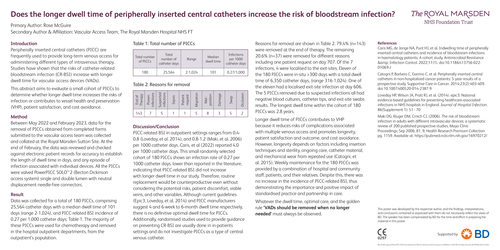
Data was collected for a total of 180 PICCs, comprising 25,564 catheter days with a median dwell time of 101 days (range 2-1,024), and PICC-related BSI incidence of 0.27 per 1,000 catheter days; Table 1. The majority of these PICCs were used for chemotherapy and removed in the hospital outpatient departments, from the outpatient’s population.
Discussion/Conclusion
PICC-related BSI in outpatient settings ranges from 0.4- 0.8 (Loveday, et al. 2014), and 0.8-1.2 (Maki, et al. 2006) per 1000 catheter days. Caris, et al (2022) reported 4.0 per 1000 catheter days. This small randomly selected cohort of 180 PICCs shows an infection rate of 0.27 per 1000 catheter days, lower than reported in the literature, indicating that PICC-related BSI did not increase with longer dwell time in our study. Therefore, routine replacement would be counterproductive even without considering the potential risks, patient discomfort, viable veins, and other variables. Although current guidelines (Epic3, Loveday, et al. 2014) and PICC manufacturers suggest 4 and 6-week to 6-month dwell time respectively, there is no definitive optimal dwell time for PICCs. Additionally, randomised studies used to provide guidance on preventing CR-BSI are usually done in in-patients settings and do not investigate PICCs as a type of central venous catheter.
Reasons for removal are shown in Table 2. 79.4% (n=143) were removed at the end of therapy. The remaining 20.6% (n=37) were removed for different reasons including one patient request on day 707. Of the 7 infections, 4 were localised to the exit-sites. Eleven of the 180 PICCs were in-situ >300 days with a total dwell time of 6,350 catheter days, (range 316-1,024). One of the eleven had a localised exit-site infection at day 606. The 5 PICCs removed due to suspected infections all had negative blood cultures, catheter tips, and exit-site swabs results. The longest dwell time within the cohort of 180 PICCs was 2.8 years.
Longer dwell time of PICCs contributes to VHP because it reduces risks of complications associated with multiple venous access and promotes longevity, patient satisfaction and outcome, and cost avoidance. However, longevity depends on factors including insertion techniques and sterility, ongoing care, catheter material, and mechanical wear from repeated use (Catogni, et al. 2015). Weekly maintenance for the 180 PICCs was provided by a combination of hospital and community staff, patients, and their relatives. Despite this, there was no increase in the incidence of PICC-related BSI, thus demonstrating the importance and positive impact of standardised practice and partnership in care. Whatever the dwell time, optimal care, and the golden rule ‘VADs should be removed when no longer needed’ must always be observed.
References
Caris MG, de Jonge NA, Punt HJ, et al. Indwelling time of peripherally inserted central catheters and incidence of bloodstream infections in haematology patients: A cohort study. Antimicrobial Resistance & Infection Control. 2022;11(1). doi:10.1186/s13756-022- 01069-z
Catogni P, Barbero C, Garrino C, et al. Peripherally inserted central catheters in non-hospitalized cancer patients: 5-year results of a prospective study. Supportive Care in Cancer. 2014;23(2):403-409. doi:10.1007/s00520-014-2387-9
Loveday HP, Wilson JA, Pratt RJ, et al. (2014). epic3: National evidence-based guidelines for preventing healthcare-associated infections in NHS hospitals in England. Journal of Hospital Infection. 86(Supplement 1): S1 - 70
Maki DG, Kluger DM, Crnich CJ. (2006). The risk of bloodstream infection in adults with different intravascular devices: a systematic review of 200 published prospective studies. Mayo Clinic Proceedings; Sep 2006; 81, 9; Health Research Premium Collection pg. 1159. Available at: https://pubmed.ncbi.nlm.nih.gov/16970212/