140 posters, 10 videos, 15 audios, 20 sessions, 508 authors, 204 institutions
ePostersLive by SciGen Technologies S.A. All rights reserved.
8th World Congress on Vascular Access 2024
April 17 - 19, 2024 | Prague, Czech Republic

43
Peripheral vascular catheter fixation. key to reducing complications. A randomized study.
Poster Presenter
Part of Topic
Video
Audio
Peripheral vascular catheter fixation. Key to reducing complications. A randomized study.
AUTHORS: Corcuera Martinez MI. 1, Ferraz Torres M.1,2,3, Sancho Sena E. 1 Martínez García O 1
INSTITUTION:1 Hospital Universitario de Navarra. 2 Universidad pública de Navarra. 3 IdiSNA.
Background and objective:
Evaluate the performance of different types of dressings for the securement of peripherally inserted catheters. Previous studies have not demonstrated the effectiveness of the different types of dressings in reducing the rate of complications. The purpose of this study was to determine which type of dressing is most beneficial in reducing the rate of complications.
Methods:
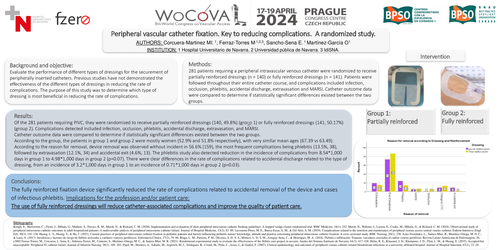
281 patients requiring a peripheral intravascular venous catheter were randomized to receive partially reinforced dressings (n = 140) or fully reinforced dressings (n = 141). Patients were followed throughout their entire catheter course, and complications included infection, occlusion, phlebitis, accidental discharge, extravasation and MARSI. Catheter outcome data were compared to determine if statistically significant differences existed between the two groups.
Intervention:
Group 1: Partially reinforced dressing
Group 2: Fully reinforced dressing
Results:
Of the 281 patients requiring PIVC, they were randomized to receive APR (140, 49.8%) or RTA (141, 50.17%). Complications detected included infection, occlusion, phlebitis, accidental discharge, extravasation, and MARSI. Catheter outcome data were compared to determine if statistically significant differences existed between the two groups. According to the group, the patients in group 1 and group 2 were mostly women (52.9% and 51.8% respectively), with very similar mean ages (67.39 vs 63.49). According to the reason for removal, device removal was observed without incident in 56.6% (159), the most frequent complication s being phlebitis (13.5%, 38), followed by extravasation (12.1%, 34) and accidental exit (4.6%, 13). The phlebitis study also detected reduction in the incidence of complications from 8.54*1,000 days in group 1 to 4.98*1,000 days in group 2 (p=0.07). There were clear differences in the rate of complications related to accidental discharge related to the type of dressing, from an incidence of 3.2*1,000 days in group 1 to an incidence of 0.71*1,000 days in group 2 (p=0.03).
Conclusions:
The fully reinforced fixation device significantly reduced the rate of complications related to accidental removal of the device and cases of infectious phlebitis. Implications for the profession and/or patient care: The use of fully reinforced dressings will reduce catheter associated complications and improve the quality of patient care
Bibliography:
Keogh, S., Shelverton, C., Flynn, J., Mihala, G., Mathew, S., Davies, K. M., Marsh, N., & Rickard, C. M. (2020). Implementation and e valuation of short peripheral intravenous catheter flushing guidelines: A stepped wedge cluster randomized trial. BMC Medicine, 18(1), 252. Marsh, N., Webster, J., Larsen, E., Cooke, M., Mihala, G., & Rickard, C. M. (2018). Observational study of peripheral intravenous catheter outcomes in adult hospitalized patients: A multivariable analysis of peripheral intravenous catheter failure. Journal of Hospital Medicine, 13(2), 83- 89. Lacostena Pérez, M. E., Buesa Escar, A. M., & Gil Alós, A. M. (2019). Complications related to the insertion and maintenance of peripheral venous access central venous catheter. Enferm Intensiva (En glEd), 30(3), 116 126. Huang, L. S., Huang, Y., & Hu, J. (2021). Current practices of peripheral intravenous catheter fixation in pediatric patients and factors influencing pediatric nurses’ knowledge, attitude and practice concerning peripheral intravenous catheter fixation: A cross-sectional study. BMC Nursing, 20(1), 236. Arias Fernández, L., Suárez Mier, B., Martínez Ortega, M. D . C.,& Lana, A. (2017). Incidencia y factores de riesgo de flebitis asociadas a catéteres venosos periféricos. Enfermería 27 (2), 79 86. Braga, L. M., Parreira, P. M., Oliveira, A. D. S. S., Mónico, L. D. S. M., Arreguy Sena, C., & Henriques, M. A. (201 8). Flebitis e infiltración: Traumas vasculares asociados al catéter venoso periférico. Revista Latino Americana de Enfermagem, 26,e3002 Ferraz Torres , M., Corcuera, I., Sena, E., Aldonza Torres, M., Centeno, S., Martínez Ortega, M. C., & Suárez Mier, M. B. (2021). Randomized experimental study to evaluate the effectiveness of the flebitis zero project in navarre. Anales del Sistema Sanitario de Navarra , 44(3), 417 426. Helm, R. E., Klausner, J. D., Klemperer, J. D., Flint, L. M., & Huang, E. (2015). Accepted but unacceptable: Peripheral IV catheter failure. Journal of Infusion Nursing, 38(3), 189 203. Pujol, M., Hornero, A., Saballs, M., Argerich, M. J., Verdaguer, R., Cisnal, M., Peña, C., Ariza, J., & Gudiol, F. (2007). Clinical epidemiology and outcomes of peripheral venous catheter related bloodstream infections at a university affiliated hospital. Journal of Hospital Infection, 67(1), 22 29.