140 posters, 10 videos, 15 audios, 20 sessions, 508 authors, 204 institutions
ePostersLive by SciGen Technologies S.A. All rights reserved.
8th World Congress on Vascular Access 2024
April 17 - 19, 2024 | Prague, Czech Republic

42
TIVAD and IC-ECG in children
Poster Presenter
Part of Topic
Video
Introduction:
A portacath is a valuable tool for supportive care, repeated blood sampling, and therapy, especially in children with malignancies or metabolic disorders. GAVeCeLT has released an insertion bundle called SIC-Ped (Safe Insertion of Central Access in Pediatric Patients), which has been widely adopted globally. However, there are still some local concerns about following it during the insertion of TIVAD (Totally Implanted Vascular Access Device), with still popular fluoroscopy, commonly used for catheter tip location.
Objectives and method :
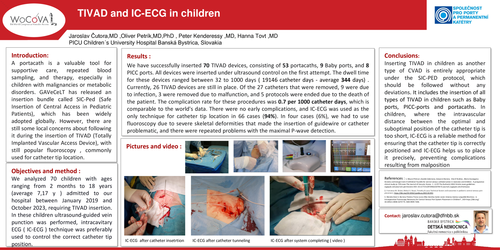
We analyzed 70 children with ages ranging from 2 months to 18 years (average 7,17 y ) admitted to our hospital between January 2019 and October 2023, requiring TIVAD insertion. In these children ultrasound-guided vein punction was performed, intracavitary ECG ( IC-ECG ) technique was preferably used to control the correct catheter tip position.
Results :
We have successfully inserted 70 TIVAD devices, consisting of 53portacaths, 9 Baby ports, and 8 PICC ports. All devices were inserted under ultrasound control on the first attempt. The dwell time for these devices ranged between 32 to 1000 days(19146 catheter days - average 344 days) . Currently, 26 TIVAD devices are still in place. Of the 27 catheters that were removed, 9 were due to infection, 3 were removed due to malfunction, and 5 protocols were ended due to the death of the patient. The complication rate for these procedures was 0.7 per 1000 catheter days, which is comparable to the world's data. There were no early complications, and IC-ECG was used as the only technique for catheter tip location in 66 cases (94%). In four cases (6%), we had to use fluoroscopy due to severe skeletal deformities that made the insertion of guidewire or catheter problematic, and there were repeated problems with the maximal P-wave detection.
Conclusions:
Inserting TIVAD in children as another type of CVAD is entirely appropriate under the SIC-PED protocol, which should be followed without any deviations. It includes the insertion of all types of TIVAD in children such as Baby ports, PICC-ports and portacaths. In children, where the intravascular distance between the optimal and suboptimal position of the catheter tip is too short, IC-ECG is a reliable method for ensuring that the catheter tip is correctly positioned and IC-ECG helps us to place it precisely, preventing complications resulting from malposition