140 posters, 10 videos, 15 audios, 20 sessions, 508 authors, 204 institutions
ePostersLive by SciGen Technologies S.A. All rights reserved.
8th World Congress on Vascular Access 2024
April 17 - 19, 2024 | Prague, Czech Republic

253
Chlorhexedine and Silver Impregnated Silicone Dressing: Case Report in Patients with Catheter Associated Skin Impairment Risk
Poster Presenter
Part of Topic
Chlorhexedine and Silver Impregnated Silicone Dressing: Case Report in Patients with Catheter Associated Skin Impairment Risk
Kelly Onaga Jahana1, Telma Christina do Campo Mazzetto1, Fernanda Nogueira Calore1, Renato Souza1, Karen Cristina de Souza Eckert 1, Renata Gonçalves de Oliveira2, Alessandra Marin2
Background
Chlorhexidine (CHG) impregnated dressings are recommended to prevent infection.1 The frequent changing dressing can damage the skin, and impairment the skin's barrier function, making them highly susceptible to Catheter Associated Skin Impairment (CASI) and infections. 2,3. This emerging area requires more researches and different option for patients.
Objective
To report the use of a CHG and silver impregnated silicone dressing in patients at risk of
CASI.
Methods
This is a descriptive and observational case report, conducted in a large philanthropic hospital in São Paulo, Brazil. Data was collected through skin examination and photographic records, respecting confidentiality, and patient identification. Data was collected from July to September 2023 from a total of 24 patients with PICC lines. The patient's MARSI risk profile was selected before catheter insertion, according to the presence of one of the following factors: thin skin, poor dermal-epidermal junction, reduced elasticity and resistance, dryness, history of CASI, by nurses specialized in vascular access trained for this evaluation. These same professionals were responsible for inserting the venous catheter, choosing the catheter cover, and maintaining, in this case, the silicone film impregnated with silver and CHG. No adhesive removers were used, skin antisepsis was carried out with 2% chlorhexedine alcohol solution and 70% isopropyl alcohol, occluded with impregnated silicone film, without protective skin barriers.
Results
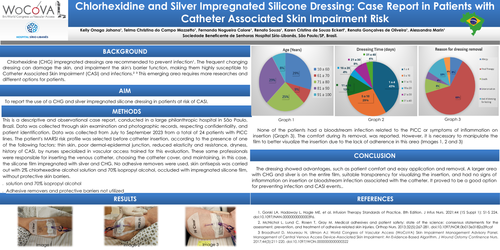
Overall, 54% of the 24 patients selected were between 71 and 90 years old, 71% remained with the PICC for between 1 and 10 days and 83% kept the film until the end of therapy. None of the patients had a bloodstream infection related to the PICC or symptoms of inflammation on insertion. The comfort during its removal, was reported. However, it is necessary to manipulate the film to better visualize the insertion due to the lack of adherence in this area.
Conclusions
The dressing showed advantages, such as patient comfort and easy application and removal. A larger area with CHG and silver is on the entire film, suitable transparency for visualizing the insertion, and had no signs of inflammation on insertion or bloodstream infection associated with the catheter. It proved to be a good option for preventing infection and CASI events.
References
1. Gorski LA, Hadaway L, Hagle ME, et al. Infusion Therapy Standards of Practice, 8th Edition. J Infus Nurs. 2021;44 (1S Suppl 1): S1-S 224. doi:10.1097/NAN.0000000000000396.
2. McNichol L, Lund C, Rosen T, Gray M. Medical adhesives and patient safety: state of the science: consensus statements for the assessment, prevention, and treatment of adhesive-related skin injuries. Orthop Nurs. 2013;32(5):267-281.
doi:10.1097/NOR.0b013e3182a39caf
3.Broadhurst D, Moureau N, Ullman AJ; World Congress of Vascular Access (WoCoVA) Skin Impairment Management Advisory Panel. Management of Central Venous Access Device-Associated Skin Impairment: An Evidence-Based Algorithm. J Wound Ostomy Continence Nurs. 2017;44(3):211-220. doi:10.1097/WON.0000000000000322