Loading...

140 posters, 10 videos, 15 audios, 20 sessions, 508 authors, 204 institutions

ePostersLive by SciGen Technologies S.A. All rights reserved.

8th World Congress on Vascular Access 2024

April 17 - 19, 2024 | Prague, Czech Republic

8th World Congress on Vascular Access 2024 banner

238

Effect of SIC protocol implementation on central venous catheter complications in hematologic patients undergoing allogeneic and autologous hematopoietic stem cell transplantation–a single center experience.
Part of Topic

Effect of SIC protocol implementation on central venous catheter complications in hematologic patients undergoing allogeneic and autologous hematopoietic stem cell transplantation – a single center experience.

Zuzana Mrkvova, Adela Prchlikova, Martina Filipova, Tomas Arpas, Samuel Hricko, Dominik Fric, Lucie Ehrlichova, Stepan Tucek, Stepan Hrabovsky.

Background

•Patients undergoing hematopoietic stem cell transplantation (HSCT) comprise a distinct category at extreme risk of severe complications, such as infections and hemorrhage.
•Most of these patients require central venous catheters (CVCs) for treatment administration.
•The implementation of the Safe Insertion of Centrally Inserted Central Catheters Protocol (SIC) into routine practice aims to prevent CVC-related complications.

Objectives and methods

•In this 5-year single-center retrospective study, we analyzed the effect of SIC protocol implementation on CVC-associated complications in patients undergoing HSCT at a major hematological/oncological center in the Czech Republic.

Results

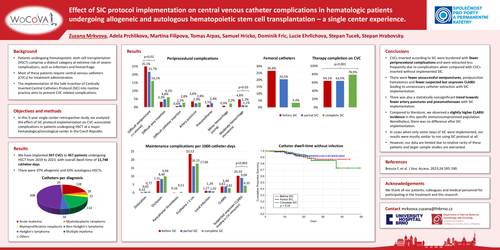
Periprocedural complications

Femoral catheters

Therapy completion on CVC

Maintenance complications per 1000 catheter-days

Catheter dwell-time without infection

•We have implanted 597 CVCs to 457 patients undergoing HSCT from 2019 to 2023, with overall dwell-time of 11,748 catheter-days.
•There were 37% allogeneic and 63% autologous HSCTs.

 Conclusions

•CVCs inserted according to SIC were burdened with fewer periprocedural complications and were extracted less frequently due to complications when compared with CVCs inserted without implemented SIC.
•There were fewer unsuccessful venipunctures, postpunction hematomas and fewer suspected but unproven CLABSI leading to unnecessary catheter extraction with SIC implementation.
•There was also a statistically nonsignificant trend towards fewer artery punctures and pneumothoraxes with SIC implementation.
•Compared to literature, we observed a slightly higher CLABSI incidence in this specific immunocompromised population. Nonetheless, there was no difference after SIC implementation.
•In cases when only some steps of SIC were implemented, our results were mostly similar to not using SIC protocol at all.
•However, our data are limited due to relative rarity of these patients and larger sample studies are warranted.

References

Brescia F, et al. J Vasc Access. 2023;24:185-190.

Acknowledgements

We thank all our patients, colleagues and medical personnel for participating in the treatment and this research.

Contact mrkvova.zuzana@fnbrno.cz

8th World Congress on Vascular Access 2024 » banner
Copyright © 2015-2026, ePostersLive® SciGen is a registered trademark of SciGen Technologies S.A. Patent pending.

This website and third-party tools we use rely on cookies for the best user experience. By selecting "I agree", you agree to cookie usage as described in our Privacy Policy.