140 posters, 10 videos, 15 audios, 20 sessions, 508 authors, 204 institutions
ePostersLive by SciGen Technologies S.A. All rights reserved.
8th World Congress on Vascular Access 2024
April 17 - 19, 2024 | Prague, Czech Republic

231
Peripherally inserted central venous catheter breakage: A case report.
Poster Presenter
Authors
Gemma Farré, Marta Galí, Gisela Arenas, Toni García, Pablo Gabriel Macedo, Christian López
Affiliations
Part of Topic
Peripherally inserted central venous catheter breakage: A case report.
Farré, Gemma; Gali, Marta; Arenas, Gisela; García, Toni; Macedo, Pablo; López, Christian.
Since 2014, in Althaia Manresa, peripherally inserted central catheters with ultrasound-guided technique (PICC) have been inserted in patients with poor venous access or who require long-term catheters. The outcome indicators have been excellent during these years, with a very low incidence rate of complications.
Intravenous chemotherapy is one of the most common cancer treatments, so the implantation of a Central Venous Catheter (CVC) is recommended for patients who require long-term treatment.
The most commonly used CVCs are fully implanted devices with a reservoir and Peripherally Inserted Central Catheters (PICC).
Although both devices present important advantages for the cancer patient, they could also pose a risk due to their complications (1). There are several significant complications related to both PICC insertion and maintenance. The most relevant would be thrombosis, phlebitis, infection, MARSI, total or partial extraction of the catheter, total or partial obstruction of the catheter and breakage or deterioration of the catheter (2). Spontaneous fracture and embolization of a catheter is a rare complication (3).
The 2021 Infusion Nurses Society (INS) guideline revision (4) and the 2021 GaVeCeLT Recommendations (5) describe catheter breakage as an avoidable complication to prevent potentially serious risks. In this report, we will focus on catheter breakage regarding a case detected in our service in 2022.
OBJECTIVES
- Early detection of breakage or deterioration of a catheter.
- Avoid possible serious complications derived from the breakage of a catheter.
MATERIAL AND METHOD
- Retrospective descriptive study of the case using clinical history.
- Systematic review of scientific literature in databases, manuals and consensus documents of scientific societies.
RESULTS
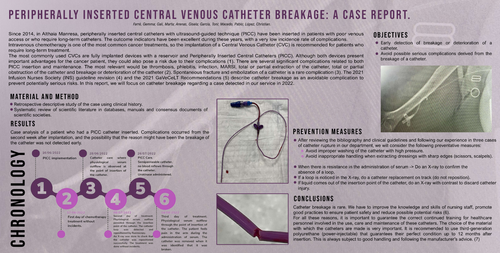
Case analysis of a patient who had a PICC catheter inserted. Complications occurred from the second week after implantation, and the possibility that the reason might have been the breakage of the catheter was not detected early.
CHRONOLOGY
- 16/06/2022 - PICC implantation.
- 17/06/2022 - First day of chemotherapy treatment without incidents.
- 28/06/2022 - Catheter care where physiological serum outflow is observed at the point of insertion of the catheter.
- 08/07/2022 - Second day of treatment. Physiological serum outflow persisted through the insertion point of the catheter. The catheter loop was detected and repositioned by fluoroscopy. An X-ray was done to check that the catheter was repositioned successfully. The treatment was done without incidents.
- 26/07/2022 - PICC Care. Semipermeable catheter, no blood reflows through the catheter. Urokinase administered.
- 04/08/2022 - Third day of treatment. Physiological serum outflow through the point of insertion of the catheter. The patient feels pain in the arm during the administration of serum. The catheter was removed when it was identified that it was broken.
PREVENTION MEASURES
After reviewing the bibliography and clinical guidelines and following our experience in three cases of catheter rupture in our department, we will consider the following preventative measures:
- Avoid improper washing of the catheter with high pressure.
- Avoid inappropriate handling when extracting dressings with sharp edges (scissors, scalpels).
- When there is resistance in the administration of serum -> Do an X-ray to confirm the absence of a loop.
- If a loop is noticed in the X-ray, do a catheter replacement on track (do not reposition).
- If liquid comes out of the insertion point of the catheter, do an X-ray with contrast to discard catheter injury.
CONCLUSIONS
Catheter breakage is rare. We have to improve the knowledge and skills of nursing staff, promote good practices to ensure patient safety and reduce possible potential risks (6).
For all these reasons, it is important to guarantee the correct continued training for healthcare personnel involved in the use, care and maintenance of these catheters.
The choice of the material with which the catheters are made is very important. It is recommended to use third-generation polyurethane (power-injectable) that guarantees their perfect condition up to 12 months after insertion. This is always subject to good handling and following the manufacturers' advice. (7)