140 posters, 10 videos, 15 audios, 20 sessions, 508 authors, 204 institutions
ePostersLive by SciGen Technologies S.A. All rights reserved.
8th World Congress on Vascular Access 2024
April 17 - 19, 2024 | Prague, Czech Republic

223
Chlorhexidine-treated Vascular Catheters Performance Against an Emerging Fungal Pathogen: <em>Candida auris</em>
Poster Presenter
Authors
Affiliations
Part of Topic
Chlorhexidine-treated Vascular Catheters Performance Against an Emerging Fungal Pathogen: Candida auris
Authors: Nisha Gupta, Shanna Haughton, and Sydney Kemper
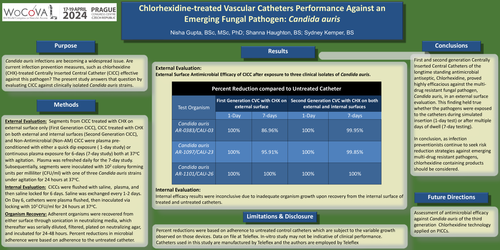
Purpose: Candida auris infections are becoming a widespread issue. Are current infection prevention measures, such as chlorhexidine (CHX)-treated Centrally Inserted Central Catheters (CICCs) effective against this pathogen? The present study answers that question by evaluating CICCs against clinically isolated Candida auris strains.
Methods:
External Evaluation: Segments from CICC treated with CHX on external surface only (First Generation CICC), CICC treated with CHX on both external and internal surfaces (Second Generation CICC), and Non-Antimicrobial (Non-AM) CICC were plasma pre-conditioned with either a quick dip exposure (1-day study) or continuous plasma exposure for 6-days (7-day study) both at 37oC with agitation. Plasma was refreshed daily for the 7-day study. Subsequentially, segments were inoculated with 102 colony forming units per milliliter (CFU/ml) with one of three Candida auris strains under agitation for 24 hours at 37oC.
Internal Evaluation: CICCs were flushed with saline, plasma, and then saline locked for 6 days. Saline was exchanged every 1-2 days. On Day 6, catheters were plasma flushed, then inoculated via locking with 102 CFU/ml for 24 hours at 37oC.
Organism Recovery: Adherent organisms were recovered from either surface through sonication in neutralizing media, which thereafter was serially diluted, filtered, plated on neutralizing agar, and incubated for 24-48 hours. Percent reductions in microbial adherence were based on adherence to the untreated catheter.
Results: Results from external evaluation are summarized in the table. Results from internal evaluation are pending.
Conclusion: Both CICCs of the longtime standing antimicrobial antiseptic, Chlorhexidine, proved highly efficacious against the multi-drug resistant fungal pathogen, Candida auris. This finding held true whether the pathogens were exposed to the catheters during simulated insertion (1-day test) or after multiple days of dwell (7-day testing).
In conclusion, as infection preventionists continue to seek risk reduction strategies against emerging multi-drug resistant pathogens, chlorhexidine containing products should be considered.