140 posters, 10 videos, 15 audios, 20 sessions, 508 authors, 204 institutions
ePostersLive by SciGen Technologies S.A. All rights reserved.
8th World Congress on Vascular Access 2024
April 17 - 19, 2024 | Prague, Czech Republic

219
The Antimicrobial Effectiveness of Chlorhexidine against a New Public Threat - Candida auris
Poster Presenter
Authors
Affiliations
Part of Topic
The Antimicrobial Effectiveness of Chlorhexidine against A New Public Threat - Candida auris
Authors: Nisha Gupta, Shanna Haughton, and Monica Koehler
Purpose:
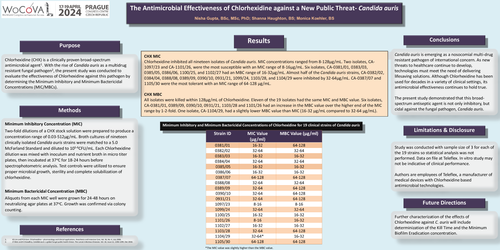
Chlorhexidine (CHX) is a clinically proven broad-spectrum antimicrobial agent. With the rise of Candida auris as a multidrug resistant fungal pathogen, the present study was conducted to evaluate the effectiveness of Chlorhexidine against this pathogen by determining the Minimum Inhibitory and Minimum Bactericidal Concentrations (MIC/MBCs).
Method:
MIC
Two-fold dilutions of a CHX stock solution were prepared to produce a concentration range of 0.03-512µg/mL. Broth cultures of 19 clinically isolated Candida auris strains were matched to a 5.0 McFarland Standard and diluted to 105-6CFU/ml. Each Chlorhexidine dilution was mixed with inoculum and nutrient broth in micro titer plates then incubated at 37oC for 18-24 hours before spectrophotometric analysis. Test controls were utilized to ensure proper microbial growth, sterility and complete solubilization of chlorhexidine.
MBC
Aliquots from each MIC well were plated and grown for 24-48 hours on agar plates at 37oC. Growth was confirmed via colony counting.
Results:
CHX inhibited all nineteen isolates of Candida auris. MIC concentrations ranged from 8-128µg/mL.
All isolates were killed within 128µg/mL of CHX. Eleven of the 19 isolates had the same MIC and MBC value. Six isolates, CA-0381/01, 0389/09, 0390/10, 0931/21, 1103/28 and 1101/26 had an increase in the MBC value over the higher end of the MIC range by 1-2-fold. Two isolates, CA-1099/24 and 1104/29, had a slightly lower MBC value than MIC (16-32 µg/mL compared to 32-64 µg/mL).
Conclusion:
Although Chlorhexidine has been used for decades in a variety of clinical settings, its antimicrobial effectiveness continues to hold true. The present study demonstrated that this broad-spectrum antiseptic agent is not only inhibitory, but cidal against the fungal pathogen, Candida auris. The findings from this study will be utilized in the evaluation of vascular access devices treated with Chlorhexidine as an active ingredient.