140 posters, 10 videos, 15 audios, 20 sessions, 508 authors, 204 institutions
ePostersLive by SciGen Technologies S.A. All rights reserved.
8th World Congress on Vascular Access 2024
April 17 - 19, 2024 | Prague, Czech Republic

217
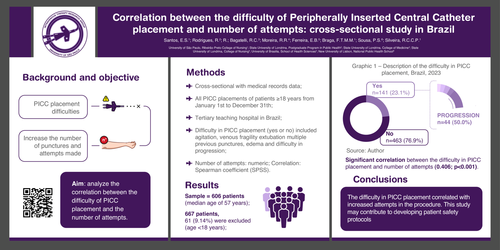
Correlation between the difficulty of Peripherally Inserted Central Catheter placement and number of attempts: cross-sectional study in Brazil
Poster Presenter
Authors
Elizângela Santos, Renne Rodrigues, Rafael Bagatelli, Rafaela Moreira, Elaine Ferreira, Fernanda Braga, Paulo Sousa, Renata Silveira
Affiliations
University of São Paulo, Ribeirão Preto College of Nursing, University of Brasilia, School of Health Sciences, State University of Londrina, Postgraduate Program in Public Health, State University of Londrina, College of Nursing, New University of Lisbon, National Public Health School, State University of Londrina, College of Medicine
Part of Topic
Video
Correlation between the difficulty of Peripherally Inserted Central Catheter placement and number of attempts: cross-sectional study in Brazil
The placement of the Peripherally Inserted Central Catheter (PICC), can present difficulties. Such difficulties increase the punctures and, consequently, the attempts made.
The aim was to analyze the correlation between the difficulty of PICC placement and the number of attempts.
Cross-sectional study analyzing medical records of patients >18 years old in a tertiary teaching hospital. The sample was of convenience, and the data collection period was from January 1 st to December 31 st, including all patients who underwent PICC insertion. Patients who were discharged with the PICC and for outpatient use were considered lost. The variable difficulty in placement (yes or no) included agitation,venous fragility, extubation, multiple previous punctures, edema and difficulty in progression. The number of attempts in the PICC placement procedure was numeric. The correlation was analyzed by calculating the Spearman Coefficient.
Of the 667 patients with PICC placement, 61 (9.14%) were excluded, totaling a sample of 606 patients. The difficulty of PICC placement was described in 140 (23.1%) procedures, the progression was the most reported difficulty (50.0%). There was a significant correlation between the difficulty in PICC placement and the number of attempts(0.406; p<0.001).
This study identified that the difficulty in PICC placement correlated with increased attempts in the placement procedure and may contribute to developing patient safety protocols. It is known that PICC placement in a single puncture reduces pain and fewer complications in the procedure. It is recommended that more studies be carried out on the subject to clarify the difficulties in PICC placement and prevention strategies.