140 posters, 10 videos, 15 audios, 20 sessions, 508 authors, 204 institutions
ePostersLive by SciGen Technologies S.A. All rights reserved.
8th World Congress on Vascular Access 2024
April 17 - 19, 2024 | Prague, Czech Republic

214
Phlebitis associated with peripheral intravenous catheter in adult oncology unit
Poster Presenter
Authors
Affiliations
Part of Topic
ACTREC, TATA MEMORIAL CENTRE, KHARGHAR, NAVI MUMBAI, INDIA
TITLE
PHLEBITIS ASSOCIATED WITH PERIPHERAL INTRAVENOUS CATHETER IN ADULT ONCOLOGY UNIT
INTRODUCTIION
Phlebitis is a common complication in patients receiving peripheral line infusions, especially vesicant/irritant drugs. Phlebitis causes disruptions in treatment and discomfort due to pain and anxiety. This study aims to determine the incidence of phlebitis among cancer patients with peripheral intravenous catheters.
METHOD
An observational study was conducted at ACTREC. A purposive sampling method was used to observe 60 surgical patients. A checklist was developed and validated. The peripheral infusion site was examined for signs of phlebitis over a period of 4 days. The severity of phlebitis was measured using the Jackson Standard Visual Infusion Phlebitis Scale. IBM V26 Software was utilized to enter, edit, and analyze the data.
RESULT
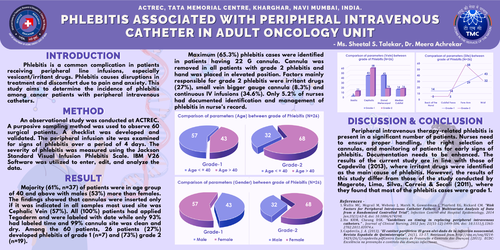
Majority (61%, n=37) of patients were in age group of 40 and above with males (53%) more than females. The findings showed that cannulas were inserted only if it was indicated in all samples most used site was Cephalic Vein (57%). All (100%) patients had applied Tegaderm and were labeled with date while only 93% had labeled time and 99% cannula site was clean and dry. Among the 60 patients, 26 patients (27%) developed phlebitis of grade 1 (n=7) and (73%) grade 2 (n=19).
Maximum (65.3%) phlebitis cases were identified in patients having 22 G cannula. Cannula was removed in all patients with grade 2 phlebitis and hand was placed in elevated position. Factors mainly responsible for grade 2 phlebitis were irritant drugs (27%), small vein bigger gauge cannula (8.3%) and continuous IV infusions (34.6%). Only 5.2% of nurses had documented identification and management of phlebitis in nurse’s record.
DISCUSSION & CONCLUSION
Peripheral intravenous therapy-related phlebitis is present in a significant number of patients. Nurses need to ensure proper handling, the right selection of cannulas, and monitoring of patients for early signs of phlebitis. Documentation needs to be enhanced. The results of the current study are in line with those of Capdevila (2013), where irritant drugs were identified as the main cause of phlebitis. However, the results of this study differ from those of the study conducted by Magerote, Lima, Silva, Correia & Secoli (2011), where they found that most of the phlebitis cases were grade 1.
References -
- Wallis MC, Mcgrail M, Webster J, Marsh N, Gowardman J, Playford EG, Rickard CM. “Risk Factors for Peripheral Intravenous Catheter Failure: A Multivariate Analysis of Data from a Randomized Controlled Trial”, Infection Control and Hospital Epidemiology, 2014 Jan;35(1):63-8, doi: 10.1086/674398.
- Ho KHM, Cheung DSK. “Guidelines on timing in replacing peripheral intravenous catheters.”, Journal of Clinical Nursing, 2012 Jun; 21(11-12):1499-506, doi: 10.1111/j.1365- 2702.2011.03974.x.
- Capdevila, J. A. (2013). “El catéter periférico: El gran olvi-dado de la infección nosocomial. Revista Española de Quimioterapia”, 26(1), 13-17. Retrieved from http://seq.es/seq/0214-3429/26/1/capdevila.pdfCentro Europeu de Prevenção e Controlo das Doenças. (2011). ECDC: Excelência na prevenção e controlo das doenças infecciosas.