140 posters, 10 videos, 15 audios, 20 sessions, 508 authors, 204 institutions
ePostersLive by SciGen Technologies S.A. All rights reserved.
8th World Congress on Vascular Access 2024
April 17 - 19, 2024 | Prague, Czech Republic

208
Association of interruption of peripheral intravenous therapy and the site of placement in the wrist: prospective cohort in Brazil
Poster Presenter
Authors
Elizângela Santos, Renne Rodrigues, Rafaela Moreira, Rafael Bagatelli, Elaine Ferreira, Fernanda Braga, Paulo Sousa, Renata Silveira
Affiliations
University of São Paulo, Ribeirão Preto College of Nursing, University of Brasilia, School of Health Sciences, University of São Paulo, Ribeirão Preto College of Nursing, University of São Paulo, Ribeirão Preto College of Nursing, State University of Londrina, Postgraduate Program in Public Health, State University of Londrina, College of Nursing, New University of Lisbon, National Public Health School, State University of Londrina, College of Medicine
Part of Topic
Video
Association of interruption of peripheral intravenous therapy and the site of placement in the wrist: prospective cohort in Brazil
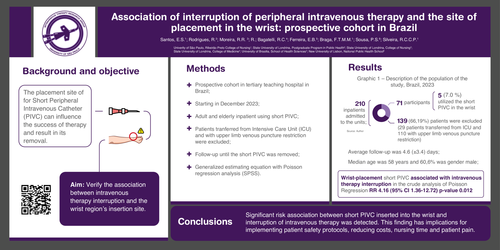
Selecting the placement site for Short Peripheral Intravenous Catheters (Short PIVC) significantly influences the success of Peripheral Intravenous Therapy (PIT). Several factors are linked to the failure of Short PIVC, predominantly resulting in its removal. This study aimed to ascertain the association between intravenous therapy interruption and the wrist region'sinsertion site.
A prospective cohort study was conducted in a tertiary teaching hospital with adult and elderly patients using short PIVC, starting in December 2023. Patients transferred from the intensive care unit and those with upper limbvenous puncture restrictions were excluded. Follow-up was performed until the short PIVC was removed. Generalized estimating equation with Poisson regression analysis was performed.
A population of 210 inpatients was admitted to the units. In total, 139 (66.19%) were excluded, totaling 71 participants. The average follow-up time was 4.6 (±3.4) days. The median agewas 58 years, predominantly gender male (60.6%). Among these, 5 (7.0%) utilized the short PIVC in the wrist region. A wrist-placement short PIVC was associated with intravenous therapy interruption in the crude analysis of Poisson Regression; RR 4.16 (95% CI 1.36-12.72), p-value 0.012.
This study revealed a significant risk association between short PIVC inserted into the wrist and interruption of intravenous therapy. This finding has implications for implementing patient safety protocols, ensuring the continuity of the PIT, thus reducing costs and nursing time.This approach can mitigate the need for additional punctures, increasing patient and family comfort and satisfaction.