140 posters, 10 videos, 15 audios, 20 sessions, 508 authors, 204 institutions
ePostersLive by SciGen Technologies S.A. All rights reserved.
8th World Congress on Vascular Access 2024
April 17 - 19, 2024 | Prague, Czech Republic

200
Life beyond the line: Patient Reported Experiences with TIVAD and maintenance.
Poster Presenter
Part of Topic
Life beyond the line: Patient Reported Experiences with TIVAD and maintenance.
Y. Peeters, RN, MSc1, T. Douchy, MD3, M. Jérôme, RN, MSc1, E. Van Der Mynsbrugge, RN1, D. Hompes, MD, PhD3, V. Boecxstaens, MD, PhD3 G.A. Goossens, RN, PhD1,2
Background and objective
Totally Implantable Venous Access Devices (TIVADs) signify more than a device to administer
intravenous therapy for patients. It is a foreign object in their body, which they need to cope with during
and after treatment. This study is part of the Port REMoval Outcomes (PREMO) study (NCT03948958)
and aims to assess patient satisfaction with TIVADs through Patient-Reported Experience Measures
(PREMs).
Methods:
Between 2019 to 2022, 100 patients undergoing end of therapy (elective) TIVAD removal were enrolled.
Patient’s experiences were assessed with the Leuven Patient Reported Experiences at Port removal
(PREP) questionnaire which includes 24 PREMs linked to TIVAD insertion, use, maintenance period and
removal. PREMs were summarized into 3 domains: Emotional and Psychological impact (EPI), Physical
Comfort and Daily Activities (PCDA) and Perceptions of the Implantation Area (PIA). We assessed the
general experience of the quarterly flushing. Additionally, general satisfaction with the TIVAD was rated
with a Numeric Rating Scale (NRS).
Results:
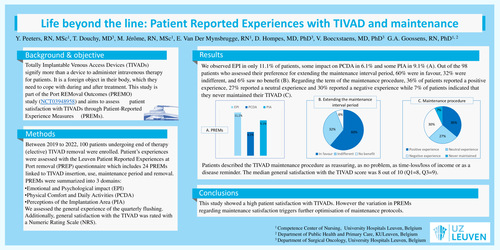
We observed EPI in only 11.1% of patients, some impact on PCDA in 6.1% and some PIA in 9.1%. Out of
the 98 patients who assessed their preference for extending the maintenance interval period, 60% were in
favour, 32% were indifferent, and 6% saw no benefit. Regarding the term of the maintenance procedure,
36% of patients reported a positive experience, 27% reported a neutral experience and 30% reported a
negative experience while 7% of patients indicated that they never maintained their TIVAD.
Patients described the TIVAD maintenance procedure as reassuring, as no problem, as time-loss/loss of
income or as a disease reminder. The median general satisfaction with the TIVAD score was 8 out of 10
(Q1=8, Q3=9).
Conclusions:
This study showed a high patient satisfaction with TIVADs. However the variation in PREMs regarding
maintenance satisfaction triggers further optimisation of maintenance protocols.
1 Competence Center of Nursing, University Hospitals Leuven, Belgium
2 Department of Public Health and Primary Care, KULeuven, Belgium
3 Department of Surgical Oncology, University Hospitals Leuven, Belgium