140 posters, 10 videos, 15 audios, 20 sessions, 508 authors, 204 institutions
ePostersLive by SciGen Technologies S.A. All rights reserved.
8th World Congress on Vascular Access 2024
April 17 - 19, 2024 | Prague, Czech Republic

196
Prolonged administration of intravenous medication through midline compared to standard PIVC: The PIMMS randomized controlled trial.
Poster Presenter
Authors
Tricia Kleidon, Victoria Gibson, Jessica Schults, Ruth Royle, Robert Ware, Nicole Marsh, Joshua Byrnes, Claire Rickard, Amanda Ullman
Affiliations
University of Queensland, Royal Brisbane and Women's Hospital, Griffith University, Queensland Children's Hospital, Univeristy of Queensland, Statistician
Part of Topic
Prolonged administration of Intravenous Medication through Midline compared to Standard PIVC:
The PIMMS randomized controlled trial.
TriciaM Kleidon RN MNursPrac, Victoria Gibson RN GC Child Health, Paula Cattanach RN, Jessica Schults RN PhD, Ruth H Royle MEcon, Robert S Ware PhD, Nicole Marsh RN PhD, Colleen Pitt RN, Anna Dean RN, Joshua Byrnes PhD, Claire M Rickard RN PhD, Amanda J Ullman RN PhD
Background
Peripheral intravenous catheterization (PIVC) is a one of the most painful inpatient procedures across children’s hospital admissions. Approximately 30-50% of PIVCs fail (dislodgement, extravasation/infiltration, infection, device occlusion, pain, phlebitis, and thrombosis) prematurely causing interruption to therapy, pain, re-catheterization, escalation to a more invasive intravascular device, and additional healthcare costs.
Midline Catheters are a peripheral device that are an alternative to traditional PIVCs. They are a longer length device, and usually inserted in an upper arm vein with the tip terminating at or distal to the axillary vein, outside the thoracic cavity.
Purpose
Methods
Results – What are the findings?
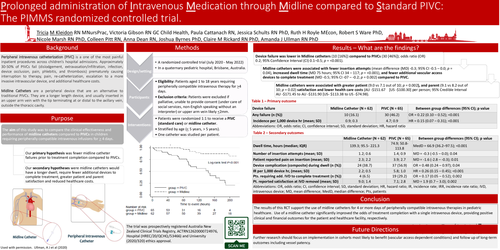
Device failure was lower in Midline catheters (10 [16%]) compared to PIVCs (30 [46%]); odds ratio (OR) 0.2; 95% Confidence Interval (CI) 0.1–0.5; p = <0.001).
Midline catheters were associated with fewer insertion attempts (mean difference (MD) -0.3; 95% CI -0.5 – 0.0; p = 0.04), increased dwell time (MD 75 hours; 95% CI 34 – 117; p = <0.001), and fewer additional vascular access devices to complete treatment (MD -0.5; 95% CI -07 – -0.2; p = 0.002) compared to PIVC.
Midline catheters were associated with greater patient (9.0 vs 7.1 out of 10; p = 0.002), and parent (9.1 vs 8.2 out of 10; p = 0.02) satisfaction and lower health care costs (AU -$151.67 [US -$100.30] per person; 95% Credible Interval AU -$171.45 to AU -$131.90 [US- $113.38 to US -$74.98).
Conclusion
The results of this RCT support the use of midline catheters for 4 or more days of peripherally compatible intravenous therapies in pediatric healthcare. Use of a midline catheter significantly improved the odds of treatment completion with a single intravenous device, providing positive clinical and financial outcomes for the patient and healthcare facility, respectively.
Future directions
Further research should focus on implementation in cohorts most likely to benefit (vascular access dependent conditions) and follow up of long-term outcomes including vessel patency.