140 posters, 10 videos, 15 audios, 20 sessions, 508 authors, 204 institutions
ePostersLive by SciGen Technologies S.A. All rights reserved.
8th World Congress on Vascular Access 2024
April 17 - 19, 2024 | Prague, Czech Republic

189
PORT-A-CATH CATHETER INFECTION SHORTLY AFTER IMPLANTATION: PRESENTATION OF TWO CASES FROM OUR DEPARTMENT
Poster Presenter
Part of Topic
PORT-A-CATH CATHETER INFECTION SHORTLY AFTER IIMPLANTATION: PRESENTATION OF TWO CASES FROM OUR DEPARTMENT
Ioannidis Orestis, Elissavet Anestiadou, Konstantinos Siozos, Lydia Loutzidou, Panagiotis Charitidis, Konstantinos Zapsalis, Manousos-George Pramateftakis, Efstathios Kotidis, Vasileios Foutsitzis, Stamatios Angelopoulos
4th Department of Surgery, Medical School, Aristotle University of Thessaloniki, General Hospital “George Papanikolaou”, Thessaloniki, Greece
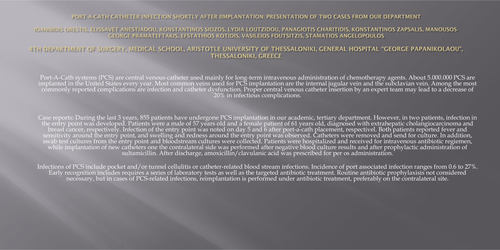
Introduction: Port-Α-Cath systems (PCS) are central venous catheter used mainly for long-term intravenous administration of chemotherapy agents. About 5.000.000 PCS are implanted in the United States every year. Most common veins used for PCS implantation are the internal jugular vein and the subclavian vein. Among the most commonly reported complications are infection and catheter dysfunction. Proper central venous catheter insertion by an expert team may lead to a decrease of 20% in infectious complications. Our study aims to present management of infection development in the entry point of the PCS in two patients.
Case reports: During the last 3 years, 855 patients have undergone PCS implantation in our academic, tertiary department. However, in two patients, infection in the entry point was developed. Patients were a male of 57 years old and a female patient of 61 years old, diagnosed with extrahepatic cholangiocarcinoma and breast cancer, respectively. Infection of the entry point was noted on day 5 and 6 after port-a-cath placement, respectively, and symptomatology included fever, swelling and redness around the entry point. Catheters were removed and send for culture. In addition, swab test cultures from the entry point and bloodstream cultures were collected. Patients were hospitalized and received for intravenous antibiotic regiemen, while implantation of new catheters one the contralateral side was performed after negative blood culture results and after prophylactic administration of sultamicillin. After discharge, amoxicillin/clavulanic acid was prescribed for per os administration.
Conclusion: Infections of PCS include pocket and/or tunnel cellulitis or catheter-related blood stream infections. Incidence of port associated infection ranges from 0.6 to 27%. Early recognition includes requires a series of laboratory tests as well as the targeted antibiotic treatment. Routine antibiotic prophylaxisis not considered necessary, but in cases of PCS-related infections, reimplantation is performed under antibiotic treatment.