140 posters, 10 videos, 15 audios, 20 sessions, 508 authors, 204 institutions
ePostersLive by SciGen Technologies S.A. All rights reserved.
8th World Congress on Vascular Access 2024
April 17 - 19, 2024 | Prague, Czech Republic

185
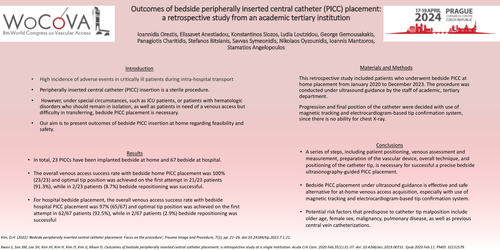
Outcomes of bedside peripherally inserted central catheter (PICC) placement: a retrospective study from an academic tertiary institution
Poster Presenter
Part of Topic
Outcomes of bedside peripherally inserted central catheter (PICC) placement:
a retrospective study from an academic tertiary institution
Ioannidis Orestis, Elissavet Anestiadou, Konstantinos Siozos, Lydia Loutzidou, George Gemousakakis,
Panagiotis Charitidis, Stefanos Bitsianis, Savvas Symeonidis, Nikolaos Oyzounidis, Ioannis Mantzoros,
Stamatios Angelopoulos
Introduction
• High incidence of adverse events in critically ill patients during intra-hospital transport
• Peripherally inserted central catheter (PICC) insertion is a sterile procedure.
• However, under special circumstances, such as ICU patients, or patients with hematologic
disorders who should remain in isolation, as well as patients in need of a venous access but
difficulty in transferring, bedside PICC placement is necessary.
• Our aim is to present outcomes of bedside PICC insertion at home regarding feasibility and
safety.
Materials and Methods
This retrospective study included patients who underwent bedside PICC at
home placement from January 2020 to December 2023. The procedure was
conducted under ultrasound guidance by the staff of academic, tertiary
department.
Progression and final position of the catheter were decided with use of
magnetic tracking and electrocardiogram-based tip confirmation system,
since there is no ability for chest X-ray.
Results
• In total, 23 PICCs have been implanted bedside at home and 67 bedside at hospital.
• The overall venous access success rate with bedside home PICC placement was 100%
(23/23) and optimal tip position was achieved on the first attempt in 21/23 patients
(91.3%), while in 2/23 patients (8.7%) bedside repositioning was successful.
• For hospital bedside placement, the overall venous access success rate with bedside
hospital PICC placement was 97% (65/67) and optimal tip position was achieved on the first
attempt in 62/67 patients (92.5%), while in 2/67 patients (2.9%) bedside repositioning was
successful
Conclusions
• A series of steps, including patient positioning, venous assessment and
measurement, preparation of the vascular device, overall technique, and
positioning of the catheter tip, is necessary for successful a precise bedside
ultrasonography-guided PICC placement.
• Bedside PICC placement under ultrasound guidance is effective and safe
alternative for at-home venous access acquisition, especially with use of
magnetic tracking and electrocardiogram-based tip confirmation system.
• Potential risk factors that predispose to catheter tip malposition include
older age, female sex, malignancy, pulmonary disease, as well as previous
central vein catheterizations.
Kim, D.H. (2022) ‘Bedside peripherally inserted central catheter placement: Focus on the procedure’, Trauma Image and Procedure, 7(1), pp. 21–26. doi:10.24184/tip.2022.7.1.21.
Kwon S, Son SM, Lee SH, Kim JH, Kim H, Kim JY, Kim JI, Moon IS. Outcomes of bedside peripherally inserted central catheter placement: a retrospective study at a single institution. Acute Crit Care. 2020 Feb;35(1):31-37. doi: 10.4266/acc.2019.00731. Epub 2020 Feb 11. PMID: 32131579.