140 posters, 10 videos, 15 audios, 20 sessions, 508 authors, 204 institutions
ePostersLive by SciGen Technologies S.A. All rights reserved.
8th World Congress on Vascular Access 2024
April 17 - 19, 2024 | Prague, Czech Republic

175
Risk factors and biomarker profiles associated with pediatric arterial catheter- associated proximal ischemic injuries.
Poster Presenter
Authors
Mark Weber, Amelia Demopoulos, Eileen Nelson, Lauren Brennan, Hongyan Liu, Monica Ryan, Alexandra Billings, Jean-Anne Cieplinski, Danielle Traynor, Stephanie Watts, Hannah Stinson, Daniela Davis, Amanda Ullman, Thomas Conlon
Affiliations
University of Queensland, Children's Hospital of Philadelphia,
Part of Topic
Risk Factors and Biomarker Profiles Associated with Pediatric Arterial Catheter- Associated Proximal Ischemic Injuries
Background
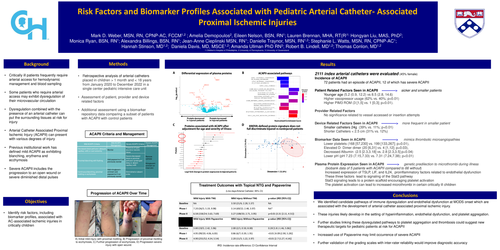
2111 index arterial catheters were evaluated (45% female)
Incidence of ACAPII
72 patients had an episode of ACAPII, 12 of which has severe ACAPII
Patient Related Factors Seen in ACAPII ------------> sicker and smaller patients
Younger age (5.2 (0.9, 12.2) vs 8.5 (2.8, 14.6)
Higher vasopressor usage (62% vs. 40%; p<0.01)
Higher PIM3 ROM (3 [1,5] vs. 1 [0,3]; p<0.01).
Provider Related Factors
No significance related to vessel accessed or insertion attempts
Device Related Factors Seen in ACAPII -------------> more frequent in smaller patient
Smaller catheters 24g (39% vs. 11%; p<0.01)
Shorter Catheters < 2.5 cm (31% vs. 12%)
Biomarker Data Seen in ACAPII ------------> mimics thrombotic microangiopathies
Lower platelets (168 [57,230] vs. 199 [133,267]; p=0.01),
Elevated D- Dimer dimer (20 [6,31] vs. 4 [1,12]; p=0.03),
Decreased Albumin (2.5 [2.3,3.18] vs. 2.8 [2.3,3.5] p=0.04)
Lower pH (pH 7.23 (7.15,7.33) vs. 7.31 (7.24,7.38); p<0.01)
Plasma Protein Expression Seen in ACAPII ---------> genetic predilection to microthrombi during illness
(biobank data of 5 patients with ACAPII compared to 66 without)
Increased expression of TSLP, LIF, and IL24, proinflammatory factors related to endothelial dysfunction
These three factors lead to signaling of the Stat3 pathway
Stat3 signaling leads to a protein scaffold encouraging platelet activation
The platelet activation can lead to increased microthrombi in certain critically ill children
Conclusions