140 posters, 10 videos, 15 audios, 20 sessions, 508 authors, 204 institutions
ePostersLive by SciGen Technologies S.A. All rights reserved.
8th World Congress on Vascular Access 2024
April 17 - 19, 2024 | Prague, Czech Republic

164
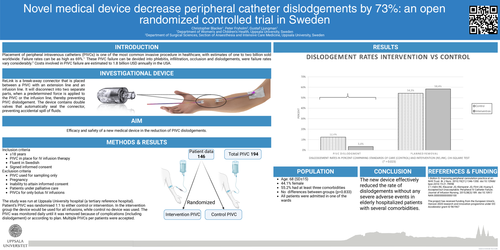
Novel medical device decrease peripheral catheter dislodgements by 72,8%: an open randomized controlled trial in Sweden.
Part of Topic
Introduction:
Placement of peripheral intravenous catheters (PIVCs) is one of the most common invasive procedure in healthcare, with estimates of one to two billion sold world wide. Failure rates can be as high as 69%.1 These PIVC failure can be devided into phlebitis, infilitration, occlusion and dislodgements, were failure rates vary considerably.2 Costs involved in PIVC failure are estimated to 1.8 billion USD annually in the USA.
Investigational device:
ReLink is a break-away connector that is placed between a PIVC with an extension line and an infusion line. It will disconnect into two seperate parts, when a predetermined force is applied to the PIVC or the infusion line, thereby preventing PIVC dislodgement. The device contains double valves that automatically seal the connector, preventing accidental spill of fluids.
Aim:
Efficacy and safety of a new medical device in the reduction of PIVC dislodgements.
Methods & Results:
Inclusion criteria:
- ≥18 years
- PIVC in place for IV infusion therapy
- Fluent in Swedish
- Signed informed consent
Exclusion criteria:
- PIVC used for sampling only
- Pregnancy
- Inability to attain informed consent
- Patients under palliative care
- PIVCs for only bolus IV infusions
The study was run at Uppsala University hospital (a tertiary reference hospital).
Patient’s PIVC was randomised 1:1 to either control or intervention. In the intervention group the device would be used for all infusions, while control no device was used. The PIVC was monitored daily until it was removed because of complications (including dislodgement) or according to plan. Multiple PIVCs per patients were accepted.
Population:
- Age: 68 (SD±15)
- 44.1% female
- 55.2% had at least three comorbidities
- No differences between groups (p=0.833)
- All patients were admitted in one of the wards
The new device effectively reduced the rate of dislodgements without any severe adverse events in elderly hospitalized patients with several comorbidities.
References & Funding:
1.Bolton D. Improving peripheral cannulation practice at an NHS Trust. Br J Nurs. 2010;19(21):1346-1350. doi:10.12968/bjon.2010.19.21.79998
2 1.Helm RE, Klausner JD, Klemperer JD, Flint LM, Huang E. Accepted but Unacceptable: Peripheral IV Catheter Failure. Journal of Infusion Nursing. 2015;38(3):189. doi:10.1097/NAN.0000000000000100
The project has received funding from the European Union's Horizon 2020 research and innovation programme under EIC Accelerator grant ID 961967