140 posters, 10 videos, 15 audios, 20 sessions, 508 authors, 204 institutions
ePostersLive by SciGen Technologies S.A. All rights reserved.
8th World Congress on Vascular Access 2024
April 17 - 19, 2024 | Prague, Czech Republic

154
Assessing External Forces on Peripheral Intravenous Catheter Movement through Ultrasound: A Randomized Pilot Investigation
Poster Presenter
Part of Topic
Audio
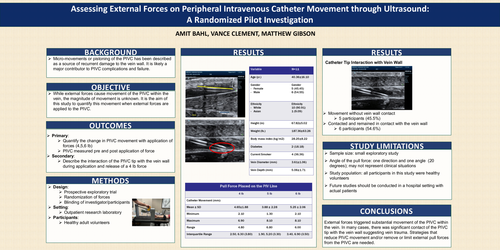
Assessing External Forces on Peripheral Intravenous Catheter Movement through Ultrasound:A Randomized Pilot Investigation
AMIT BAHL, VANCE CLEMENT, MATTHEW GIBSON
BACKGROUND
Micro-movements or pistoning of the PIVC has been described as a source of recurrent damage to the vein wall. It is likely a major contributor to PIVC complications and failure.
OBJECTIVE
While external forces cause movement of the PIVC within the vein, the magnitude of movement is unknown. It is the aim of this study to quantify this movement when external forces are applied to the PIVC.
OUTCOMES
Primary:Quantify the change in PIVC movement with application of forces (4,5,6 lb). PIVC measured pre and post application of force
Secondary: Describe the interaction of the PIVC tip with the vein wall during application and release of a 4 lb force
METHODS
Design: Prospective exploratory trial
Randomization of forces
Blinding of investigator/participants
Setting:Outpatient research laboratory
Participants: Healthy adult volunteers
RESULTS
Catheter Tip Interaction with wall:
Movement without vein wall contact
-5 participants (45.5%)
Contacted and remained in contact with the vein wall
-6 participants (54.6%)
STUDY LIMITATIONS
Sample size: small exploratory study
Angle of the pull force: one direction and one angle (20 degrees); may not represent clinical situations
Study population: all participants in this study were healthy volunteers
Future studies should be conducted in a hospital setting with actual patients
CONCLUSIONS
External forces triggered substantial movement of the PIVC within the vein. In many cases, there was significant contact of the PIVC tip with the vein wall suggesting vein trauma. Strategies that reduce PIVC movement and/or remove or limit external pull forces from the PIVC are needed.