140 posters, 10 videos, 15 audios, 20 sessions, 508 authors, 204 institutions
ePostersLive by SciGen Technologies S.A. All rights reserved.
8th World Congress on Vascular Access 2024
April 17 - 19, 2024 | Prague, Czech Republic

151
A Roaming PICC Team, the Neapolitan Model in Home Palliative Care
Poster Presenter
Authors
Caterina Bocci, Antonio Maddalena, Raffaele Nota, Sara Luciano
Affiliations
Part of Topic
Audio
A Roaming PICC Team - The Neapolitan Model in Palliative Home Care
1] OBJECTIVE
The Italian National Health Service (SSN) provides home care and pain therapy under law no. 38 of 15 March 2010. The SSN is structured into territorial organizational units called ASLs. In the city of Naples, the ASL NA 1 Centro operates, serving approximately 1,005,000 inhabitants over an area of 117 km², divided into 10 Health Districts. Within the ASL NA 1 Centro, there is the Palliative Home Care Operational Unit, which in 2023 alone followed about 1,890 patients requiring high-intensity care. Within this unit, there is also the PICC Team composed of five specialist nurses who perform stable venous vascular implants at the patients' homes, in nursing homes for the elderly (RSA), in special permanent reception units (SUAP), and in Hospices. The team caters to patients with various levels of care intensity. The implant team consists of two nurse implanters, accompanied by a driver with a service vehicle. In 2023 alone, about 420 implants were performed. Our goal is to ensure optimal patient management, therapeutic continuity, service usability, organizational coherence, and we are evaluating its further economic sustainability thanks to the PICC Team.
2] METHOD
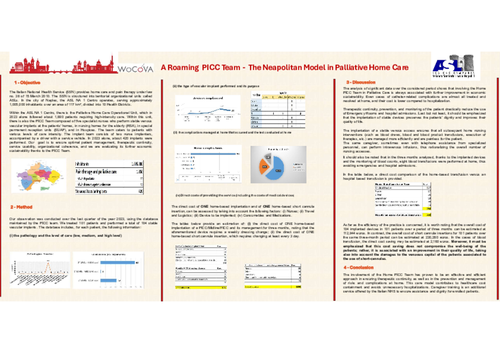
Our observation was conducted over the last quarter of the year 2023, using the database maintained by the PICC team. We treated 101 patients and performed a total of 104 stable vascular implants. The database includes, for each patient, the following information:
(i) the pathology and the level of care (low, medium, and high level care)
(ii) the type of vascular implant performed and its purpose
(iii) the complications managed at home that occurred and the test conducted at home
(iv) Direct costs of providing the service (including the costs of medical devices) The direct cost of ONE home-based implantation and of ONE home-based short cannula insertion, can be assessed by taking into account the following factors: (i) Nurses; (ii) Travel and Logistics; (iii) Device to be implanted; (iv) Consumables and Medications. The tables below provide an estimation of: (i) the direct cost of ONE home-based implantation of a PICC/Midline/FICC and its management for three months, noting that the aforementioned device requires a weekly dressing change; (ii) the direct cost of ONE home-based short cannula insertion, which requires changing at least every 3 day.
3] DISCUSSION
PICC Team in Palliative Care is always associated with further improvement in economic sustainability. Even cases of catheter-related complications are almost all treated and resolved at home, and their cost is lower compared to hospitalization. Therapeutic continuity, prevention, and monitoring of the patient drastically reduce the use of Emergency Rooms and hospital admissions. Last but not least, it should be emphasized that the implantation of stable devices preserves the patients’ dignity and improves their quality of life. The implantation of a stable venous access ensures that all subsequent home nursing interventions (such as blood draws, blood and blood product transfusions, execution of therapies, etc.) are managed more efficiently and are painless for the patient. The same caregiver, sometimes even with telephone assistance from specialized personnel, can perform intravenous infusions, thus rationalizing the overall number of nursing accesses. It should also be noted that in the three months analyzed, thanks to the implanted devices and the monitoring of blood counts, eight blood transfusions were performed at home, thus avoiding emergencies and hospital admissions. In the table below, a direct cost comparison of the home-based transfusion versus an hospital based transfusion is provided.
As far as the efficiency of the practice is concerned, it is worth noting that the overall cost of 104 implanted devices in 101 patients over a period of three months can be estimated at 112,944 euros. In contrast, the overall cost of short cannula insertions for 101 patients over the same three-month period can be estimated at 230,280 euros. In the cases of blood transfusion, the direct cost saving may be estimated at 2,160 euros. Moreover, it must be emphasized that this cost saving does not compromise the well-being of the patients; rather, it is associated with an improvement in their quality of life, taking also into account the damages to the venuous capital of the patients associated to the use of short-cannulas.
4] CONCLUSION
The involvement of the Home PICC Team has proven to be an effective and efficient approach in ensuring therapeutic continuity, as well as in the prevention and management of risks and complications at home. This care model contributes to healthcare cost containment and avoids unnecessary hospitalizations. Caregiver training is an additional service offered by the Italian NHS to ensure assistance and dignity for enrolled patients.