140 posters, 10 videos, 15 audios, 20 sessions, 508 authors, 204 institutions
ePostersLive by SciGen Technologies S.A. All rights reserved.
8th World Congress on Vascular Access 2024
April 17 - 19, 2024 | Prague, Czech Republic

143
Arm Ports in Children – Why not?
Poster Presenter
Authors
Affiliations
Part of Topic
Arm ports in children, why not?
Background
Totally implantable vascular access devices or ports are commonly used in children who require intermittent long-term central venous access. Arm ports, with a reservoir placed in the middle third of the upper arm, are an alternative to traditional chest ports. In this review we aim to present our initial experience with arm ports in children.
Methodology
This retrospective review of all arm ports inserted at the Royal Manchester Children’s Hospital was conducted from November 2022 to December 2023
Aim
Arm ports as an alternative to chest ports. The effectiveness of these devices in the paediatric population
Results
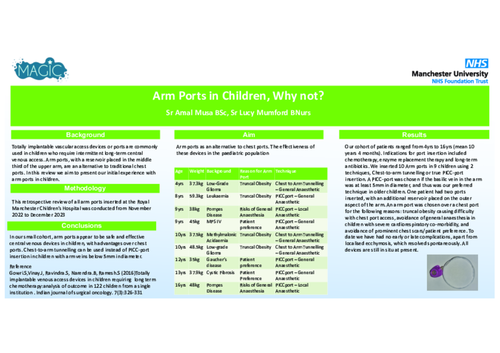
Our cohort of patients ranged from 4yrs to 16yrs (mean 10 years 4 months). Indications for port insertion included chemotherapy, enzyme replacement therapy and long-term antibiotics. We inserted 10 Arm ports in 9 children using 2 techniques, Chest-to-arm tunnelling or true PICC-port insertion. A PICC-port was chosen if the basilic vein in the arm was at least 5mm in diameter, and thus was our preferred technique in older children. One patient had two ports inserted, with an additional reservoir placed on the outer aspect of the arm. An arm port was chosen over a chest port for the following reasons: truncal obesity causing difficulty with chest port access, avoidance of general anaesthesia in children with severe cardiorespiratory co-morbidity, and avoidance of prominent chest scars/patient preference. To date we have had no early or late complications, apart from localised ecchymosis, which resolved spontaneously. All devices are still in situ at present.
Conculsion
In our small cohort, arm ports appear to be safe and effective central venous devices in children, with advantages over chest ports. Chest-to-arm tunnelling can be used instead of PICC-port insertion in children with arm veins below 5mm in diameter.
Reference
Gowri.S,Vinay.J, Ravindra.S, Narendra.B, Ramesh.S (2016)Totally implantable venous access devices in children requiring long term chemotherapy:analysis of outcome in 122 children from a single institution . Indian journal of surgical oncology. 7(3):326-331