140 posters, 10 videos, 15 audios, 20 sessions, 508 authors, 204 institutions
ePostersLive by SciGen Technologies S.A. All rights reserved.
8th World Congress on Vascular Access 2024
April 17 - 19, 2024 | Prague, Czech Republic

140
Assessing the Effects of Implemented Service Improvements on Patient Flow: A Prospective Study in a Specialized Vascular Access Unit
Poster Presenter
Part of Topic
Assessing the Effects of Implemented Service Improvements on Patient Flow:A Prospective Study in a Specialized Vascular Access Unit
Maria Giannakopoulou Lead CNS, John Alston Data for Improvement Analyst, Joanne Crofts CNS, Joanne McGee CNS, Helen Summers CNS, Erickson Dela Mines SSN, Miguel Fernandez SSN, Cristine Co SSN Cambridge University Hospitals
Introduction
The Vascular Access Unit at Cambridge University Hospitals NHS Foundation Trust, established in 2005, specializes in addressing the complex vascular access needs of patients with services ranging from ultrasound guided cannulation, line reviews, midline and central line insertions and removals. Post pandemic, the unit has experienced a notable increase in referrals, a rise from 6900 to 9600 per year between 2018-2019 and 2022-2023, as well as an uptick of deferred cases in early 2022. In response, VAU implemented a comprehensive strategy to address this and established KPI’s to monitor the effects of said service improvements from the end of 2022 to present.
Objectives
This study aims to assess the impact of implemented service improvements that were focused on workforce and the current electronic system that was in place. The study also seeks to identify sustainable changes and highlight areas requiring modification and improvement to enhance the unit’s ability to adapt to the dynamic demands for vascular access in Cambridge University Hospitals, contributing to improved and timely patient care delivery.
Methods
Data from the unit’s activity logs from 2019 to 2024 were collected and analysed. The difference between the time of completion and the point of referral was calculated to determine the number of 'roll-over days' for each case. Subsequently, these 'roll-over days' were tallied and divided by the total number of cases concluded within a given month, yielding the average 'roll-over days' per month. A target time of 0.8 'roll-over days' was established and the impact of the implemented service improvements on patient flow was evaluated against this.
Results
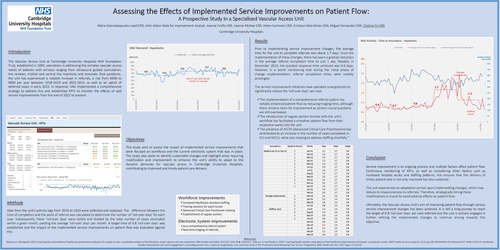
Prior to implementing service improvement changes, the average time for the unit to complete referrals was about 1.7 days. Since the implementation of these changes, there has been a gradual reduction in the average referral completion time to just 1 day. Notably, in December 2023, the quickest response time achieved was 0.6 days. However, it is worth mentioning that during the initial phase of change implementation, referral completion times were notably prolonged.
The service improvement initiatives have operated synergistically to significantly reduce the 'roll-over days' per case.
The implementation of a comprehensive referral system has notably enhanced patient flow by reducing triaging time, although there remains room for improvement as certain crucial questions are still overlooked.
Conclusion
Service improvement is an ongoing process and multiple factors affect patient flow. Continuous monitoring of KPI’s, as well as considering other factors such as increased hospital acuity and staffing patterns, this ensures that the delivery of timely patient care is not only improved but also sustained.
The unit experiences an adaptation period upon implementing changes, which may reduce its responsiveness to referrals. Therefore, strategically timing these modifications is crucial to avoid adverse effects on patient flow.
Ultimately, the Vascular Access Unit’s aim of improving patient flow through various service improvement changes has been achieved. It is still a long journey to reach the target of 0.8 'roll-over days' per case referred and the unit is actively engaged in further refining the implemented changes to continue driving towards this objective.
References
Barbazza E, Klazinga NS (2021) Exploring the actionability of healthcare performance indicators for quality of care: a qualitative analysis of the literature, expert opinion and user experience. BMJ Quality and Safety 2021;30: 1010-20 ● Enticott,J., Johnson, A. and Teede.H. (2021) 'Learning health systems using data to drive healthcare improvement and impact: a systematic review', BMC health services research, 21,(1),pp.200-200 ● White M, Butterworth T, Wells JS (2017). Healthcare Quality Improvement and 'work engagement'; concluding results from a national, longitudinal, cross-sectional study of the 'Productive Ward-Releasing Time To Care' Programme. BMC Health Serv Res. 2017 Aug 1;17 (1):510