140 posters, 10 videos, 15 audios, 20 sessions, 508 authors, 204 institutions
ePostersLive by SciGen Technologies S.A. All rights reserved.
8th World Congress on Vascular Access 2024
April 17 - 19, 2024 | Prague, Czech Republic

135
THE EFFECTIVENESS OF INTRAPROCEDURAL BRACHIOCEPHALIC VEIN SCANNINGTO PREVENT CENTRAL VENOUS CATHETER (CVC) MISPLACEMENT THROUGH AXILLARY CANNULATION
Poster Presenter
Part of Topic
THE EFFECTIVITY OF INTRAPROCEDURE BRACHIOCEPHALIC VEIN SCANNING TO PREVENT CENTRAL VENOUS CATHETER (CVC) MISPLACEMENT THROUGH AXILLARY CANNULATION
Irvan Setiawan, Putri Shabrina Amalia, Annemarie Chrysantia Melati
Critical Care Unit, Premier Bintaro Hospital, Tangerang Selatan, Indonesia
Background and objective : Axillary vein becomes a good alternative site for central venous catheter (CVC) insertion, but the axillary approach may have a risk of misplacement into the Internal Jugular Vein (IJV). This study aims to evaluate the effectivity of brachiocephalic vein scanning to prevent CVC misplacement.
Methods : This was a retrospective study was conducted at Critical Care Premier Bintaro Hospital, Indonesia. The data were collected from the electronic medical record from July 2023 to December 2023. Insertion of CVC was conducted by intensivist and using ultrasound guided. The inclusion criteria was adult patients, age 18 years and above, had CVC inserted through axillary or subclavian vein and had brachiocephalic vein scanning with ultrasound during procedure. The catheter tip position was determined by chest X-ray after the procedure.
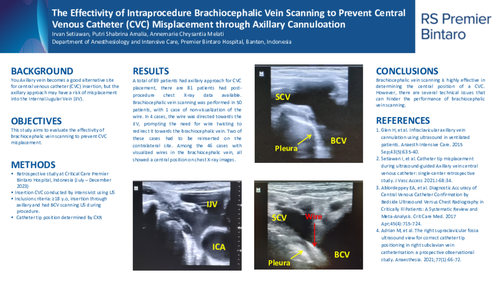
Results : A total of 89 patients had axillary approach for CVC placement, there are 81 patients had post-procedure chest X-ray data available. Brachiocephalic vein scanning was performed in 50 patients, with 1 case of non-visualization of the wire. In 4 cases, the wire was directed towards the IJV, prompting the need for wire twisting to redirect it towards the brachiocephalic vein. Two of these cases had to be reinserted on the contralateral site. Among the 46 cases with visualized wires in the brachiocephalic vein, all showed a central position on chest X-ray images.
Conclusion : Brachiocephalic vein scanning is highly effective in determining the central position of a CVC. However, there are several technical issues that can hinder the performance of brachiocephalic vein scanning.
Keywords: axillary vein, brachiocephalic vein, central vein catheter, scanning
Reference
- Glen H, et al. Infraclavicular axillary vein cannulation using ultrasound in ventilated patients. Anaesth Intensive Care. 2015 Sep;43(5):635-40.
- Setiawan I, et al. Catheter tip misplacement during ultrasound-guided Axillary vein central venous catheter: single-center retrospective study. J Vasc Access 2021.I-68:34.
- Ablordeppey EA, et al. Diagnostic Accuracy of Central Venous Catheter Confirmation by Bedside Ultrasound Versus Chest Radiography in Critically Ill Patients: A Systematic Review and Meta-Analysis. Crit Care Med. 2017 Apr;45(4):715-724.
- Adrian M, et al. The right supraclavicular fossa ultrasound view for correct catheter tip positioning in right subclavian vein catheterisation: a prospective observational study. Anaesthesia. 2021;77(1):66-72.