140 posters, 10 videos, 15 audios, 20 sessions, 508 authors, 204 institutions
ePostersLive by SciGen Technologies S.A. All rights reserved.
8th World Congress on Vascular Access 2024
April 17 - 19, 2024 | Prague, Czech Republic

132
In vitro comparison of the effectiveness of various antimicrobial locks with taurolidine in the treatment and prevention of catheter-related bloodstream infections.
Poster Presenter
Authors
Jakub Visek, Lenka Ryskova, Alena Machacova, Martina Marikova, Vladimir Blaha
Affiliations
Part of Topic
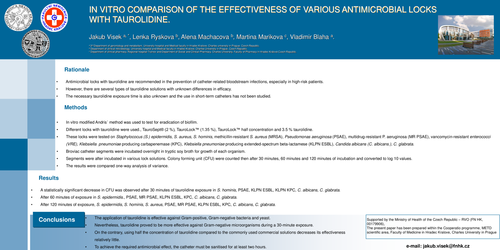
IN VITRO COMPARISON OF THE EFFECTIVENESS OF VARIOUS ANTIMICROBIAL LOCKS
WITH TAUROLIDINE.
Jakub Visek, Lenka Ryskova, Alena Machacova, Martina Marikova, Vladimir Blaha
Rationale:
•Antimicrobial locks with taurolidine are recommended in the prevention of catheter-related bloodstream infections, especially in high-risk patients.
•However, there are several types of taurolidine solutions with unknown differences in efficacy.
•The necessary taurolidine exposure time is also unknown and the use in short-term catheters has not been studied.
Methods:
•In vitro modified Andris´ method was used to test for eradication of biofilm.
•Different locks with taurolidine were used., TauroSept® (2 %), TauroLock™ (1.35 %), TauroLock™ half concentration and 3.5 % taurolidine.
•These locks were tested on Staphylococus (S.) epidermidis, S. aureus, S. hominis, methicillin-resistant S. aureus (MRSA), Pseudomonas aeruginosa (PSAE), multidrug‐resistant P. aeruginosa (MR PSAE), vancomycin-resistant enterococci (VRE), Klebsiella pneumoniae producing carbapenemase (KPC), Klebsiella pneumoniae producing extended-spectrum beta-lactamese (KLPN ESBL), Candida albicans (C. albicans.), C. glabrata.
•Broviac catheter segments were incubated overnight in tryptic soy broth for growth of each organism.
•Segments were after incubated in various lock solutions. Colony forming unit (CFU) were counted then after 30 minutes, 60 minutes and 120 minutes of incubation and converted to log 10 values.
•The results were compared one-way analysis of variance.
Results:
•A statistically significant decrease in CFU was observed after 30 minutes of taurolidine exposure in S. hominis, PSAE, KLPN ESBL, KLPN KPC, C. albicans, C. glabrata.
•After 60 minutes of exposure in S. epidermidis., PSAE, MR PSAE, KLPN ESBL, KPC, C. albicans, C. glabrata.
•After 120 minutes of exposure, S. epidermidis, S. hominis, S. aureus, PSAE, MR PSAE, KLPN ESBL, KPC, C. albicans, C. glabrata.
Conclusions:
•The application of taurolidine is effective against Gram-positive, Gram-negative bacteria and yeast.
•Nevertheless, taurolidine proved to be more effective against Gram-negative microorganisms during a 30-minute exposure.
•On the contrary, using half the concentration of taurolidine compared to the commonly used commercial solutions decreases its effectiveness relatively little.
•To achieve the required antimicrobial effect, the catheter must be sanitised for at least two hours.