140 posters, 10 videos, 15 audios, 20 sessions, 508 authors, 204 institutions
ePostersLive by SciGen Technologies S.A. All rights reserved.
8th World Congress on Vascular Access 2024
April 17 - 19, 2024 | Prague, Czech Republic

125
Observational Experiment of Catheter Reflux During Huber Needle Withdrawal
Poster Presenter
Authors
Affiliations
Part of Topic
Introduction: Over the past 30 years, the use of implanted vascular access devices (IVAD) for long term administration of vesicants, parenteral nutrition, blood products, and antimicrobials have grown exponentially. Implanted Vascular Access Devices are a vital part of patient care, improve quality of life, and help with body image. Despite the positive aspects of a port, complications can still occur. One of which is device occlusion because of blood reflux.
Methods: The observational experiment was conducted in the United Kingdom and the United States. The decision to experiment in two countries was to ensure consistency, as well as the ability to replicate the outcomes in different countries. The investigator’s goal was to reduce bias, cross-validate, and strengthen the overall credibility of the results. The experiment was comprised of investigators with diverse expertise in vascular access, and efforts were made to maintain objectivity throughout the study. The experiment was conducted by three registered nurses, one PhD, one Master’s prepared nurse, and one Bachelors prepared nurse. Who were committed to upholding the highest standards of ethics throughout all stages of the study.
The researchers in each country tested seven Huber needles to measured the fluid reflux in the port catheter upon removal. The seven commercially available Huber needles were each tested unclamped and clamped three times upon removal with a straight fluid pathway needles connector. This observational experiment was done using an in vitro port with a 6 fr catheter secured to a ruler to measure fluid reflux into the port catheter upon removal of the seven Huber needles. Each Huber and the port were flushed with red-tinted saline to observe the fluid reflux during the removal of the Huber from the port. The bevel of each Huber was oriented towards the port body catheter connection. To estimate the amount of fluid reflux, the volume was measured in centimeters upon de-accessing from the port trainer.
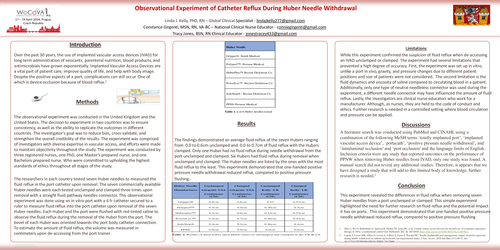
Results: The findings demonstrated an average fluid reflux of the seven Hubers ranging from 0.0 to 0.6cm unclamped and 0.0 to 0.7cm of fluid reflux with the Hubers clamped. Only one Huber had no fluid reflux during needle withdrawal from the port unclamped and clamped. Six Hubers had fluid reflux during removal when unclamped and clamped. The Huber needles are listed by the ones with the most fluid reflux to the least. This experiment demonstrated that one-handed positive pressure needle withdrawal reduced reflux, compared to positive pressure flushing.
Limitations: While this experiment confirmed the suspicion of fluid reflux when de-accessing an IVAD unclamped or clamped. The experiment had several limitations that prevented a high degree of accuracy. First, the experiment was set up in vitro, unlike a port in vivo, gravity, and pressure changes due to different patient positions and size of patients were not considered. The second limitation is the fluid dynamics and viscosity of saline compared to circulating blood in a patient. Additionally, only one type of neutral needleless connector was used during the experiment, a different needle connector may have influenced the amount of fluid reflux. Lastly, the investigators are clinical nurse educators who work for a manufacturer. Although, as nurses, they are held to the code of conduct and ethics. Further research is needed in a controlled setting where blood circulation and pressure can be applied.
Conclusion: This experiment revealed the differences in fluid reflux when removing seven Huber needles from a port unclamped or clamped. This simple experiment highlighted the need for further research on fluid reflux and the potential impact it has on ports. This experiment demonstrated that one-handed positive pressure needle withdrawal reduced reflux, compared to positive pressure flushing.