140 posters, 10 videos, 15 audios, 20 sessions, 508 authors, 204 institutions
ePostersLive by SciGen Technologies S.A. All rights reserved.
8th World Congress on Vascular Access 2024
April 17 - 19, 2024 | Prague, Czech Republic

112
A systematic review on the effectiveness of vascular access specialist teams (VAST) versus standard practice for catheter insertion and care
Poster Presenter
Part of Topic
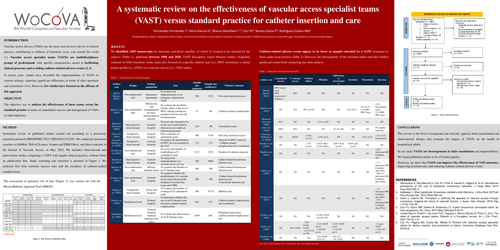
A systematic review on the effectiveness of vascular access specialist teams (VAST) versus standard practice for catheter insertion and care.
Vascular access devices (VAD) are the most used invasive device in clinical practice, counting for millions of insertions every year around the world. Vascular access specialist teams (VASTs) are multidisciplinary groups of professionals with specific competencies aimed at facilitating clinical processes and avoiding catheter-related adverse events.
The objective was to analyse the effectiveness of these teams versus the standard practice in terms of cannulation success and management of VADs in adult inpatients.
Methods.
Systematic review of published studies carried out according to a previously registered protocol (PROSPERO 2021 CRD42021231259). We conducted structured searches in Pubmed, Web of Science, Scopus and EBSCOhost, and direct searches in the Journal of Vascular Access, in May 2023. We included observational and intervention studies comparing a VAST with regular clinical practice, without limits on publication date. We analysed cannulation success rates and the incidence of catheter-related complications. The assessment of potential risk of bias was carried out with the Mixed Methods Appraisal Tool (MMAT).
Results.
We identified 3053 manuscripts by electronic and direct searches, of which 12 resulted to be selected for the analysis, published between 1984 and 2020. VAST description varied between studies, frequently centred on VAD insertions. Some teams also focused on a specific catheter type (ie. PICC insertions), a certain patient profile (ie. DIVA) or a concrete activity (ie. VAD audits). Catheter-related adverse events appear to be lower in samples attended by a VAST compared to those under usual practice. However, the heterogeneity of the included studies and their limited quality prevented from conducting any meta-analysis.
Conclusions.
In our study VASTs are heterogeneous in their constitution and responsibilities, while published studies are of limited quality. Nevertheless, the study shows that VASTs can improve the effectiveness of VAD care, improving insertion rates and reducing catheter-related adverse events.